We are constantly trying to improve ourselves in new thoughts, new technology and new working methods.

Views: 0 Author: Site Editor Publish Time: 2026-08-06 Origin: Site


There is a massive gap between entry-level hobbyist gear and serious underwater salvage equipment. You cannot rely on standard hardware store magnets to pull heavy iron relics from deep, murky rivers. While neodymium stands as the strongest permanent magnet material available today, underwater environments quickly complicate the procurement process. These subaquatic settings introduce intense physical and environmental variables. Severe corrosion, sudden sheer force, and highly irregular target surfaces drastically alter equipment performance.
This guide serves as your ultimate decision-making tool. We will help you evaluate, shortlist, and select the exact gear you need for successful retrieval. You will learn to base your choices on actual underwater performance rather than relying solely on inflated laboratory pull-force claims. By understanding subaquatic dynamics, you can safely extract heavy targets without losing your equipment.
Lab Specs vs. Reality: A magnet’s advertised pull force is tested on thick, flat, unpainted steel under ideal conditions; underwater salvage requires discounting this rating by 40-60% due to rust, debris, and surface curvature.
Configuration Matters: Choosing between single-sided, double-sided, or 360-degree magnets depends entirely on the retrieval method (vertical dropping vs. dragging).
Durability Over Raw Power: Neodymium is inherently brittle and highly susceptible to corrosion. Evaluation must prioritize heavy-duty steel casings and triple-layer (Ni-Cu-Ni) coatings.
Risk Mitigation: Equipment loss and critical injury (pinch hazards) are primary risks. Thread lockers and proper rope tensile strength are non-negotiable accessories.
Manufacturers rely on highly controlled environments to calculate maximum magnetic capacity. They test their products on pure, flat, unpainted steel plates. These plates usually measure at least 10mm thick. Testers ensure complete surface contact between the magnet and the metal. This creates the "pull force" illusion. It gives buyers a false sense of security regarding field performance.
Underwater salvage immediately strips away these perfect conditions. Water introduces severe physical barriers and dynamic forces. You must account for several critical variables before dropping your gear into a river or lake.
Surface Condition: Submerged metal rarely stays pristine. Rust, algae, and thick mud accumulate on sunken objects. These layers act as physical spacers. They prevent direct contact and exponentially weaken magnetic attraction.
Shape & Contact Area: Most salvaged items lack flat surfaces. Bicycles, old safes, and discarded tools have curved or jagged profiles. Point-contact drastically reduces the holding power of any Neodymium Fishing Magnet.
Water Dynamics: Pulling heavy objects upward creates drag. Water currents apply continuous sheer force against the side of your target. This sideways pressure significantly increases the likelihood of decoupling.
Experienced salvagers follow a strict decision rule. You must always over-index on pull force. Assume a massive power loss once the equipment hits the water. A 1,000 lb-rated magnet sounds excessive. However, it is realistically required to reliably retrieve a 150 lb irregularly shaped object from a muddy riverbed.
Condition Parameter | Laboratory Testing | Underwater Reality |
|---|---|---|
Target Material | Pure, unpainted, flat steel | Rusted, painted, curved iron |
Surface Contact | 100% flush engagement | Point-contact or edge engagement |
Interfering Elements | None (clean air environment) | Thick mud, algae, heavy water drag |
Effective Pull Force | 100% of advertised rating | 40% to 60% of advertised rating |
Selecting the proper configuration dictates your success in the field. Equipment design must match your specific retrieval technique. Throwing the wrong setup into a busy waterway often results in lost gear and missed targets.
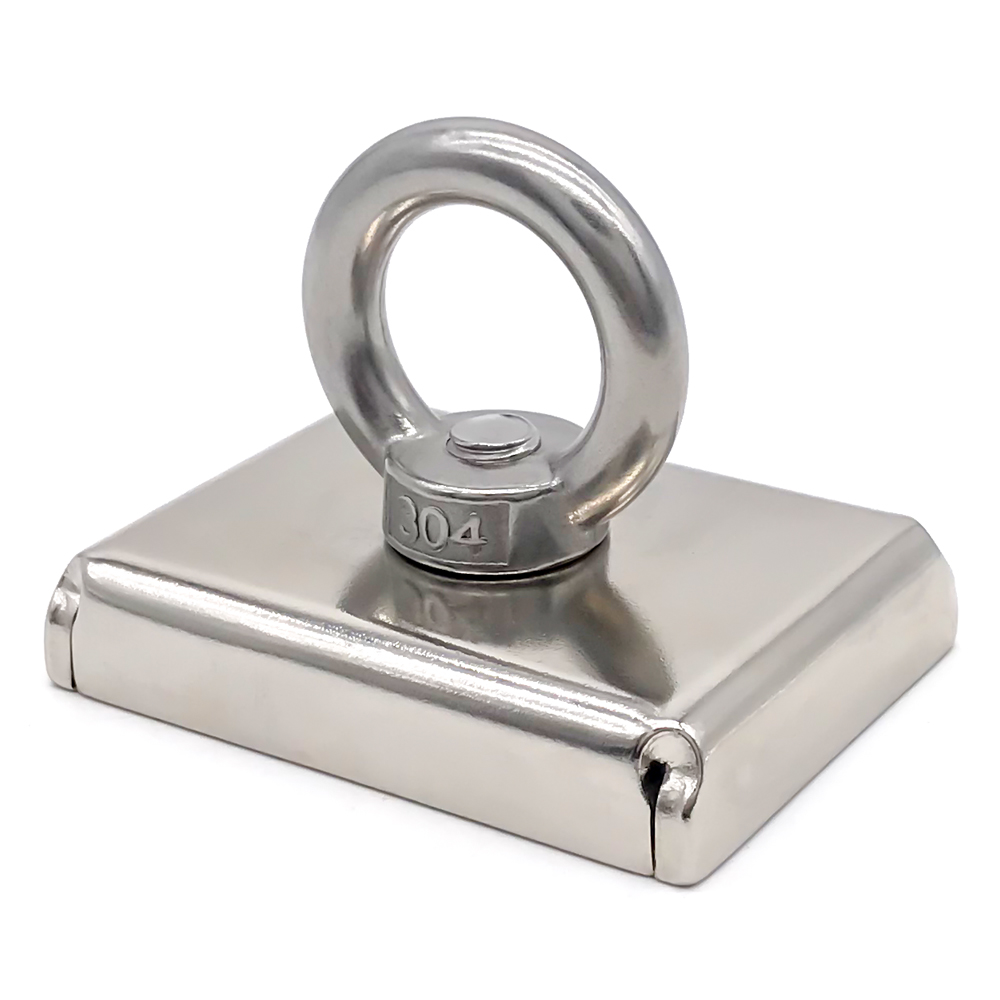
Single-sided models feature a solid steel casing with one exposed magnetic face. The eyebolt attaches directly to the top center.
Best For: Vertical drops from bridges, high docks, or stationary boats.
Pros: They concentrate all magnetic force in a single direction. This creates the maximum direct pull possible for heavy vertical extraction. The thick steel cup provides excellent impact protection.
Cons: They perform poorly for dragging operations. If you toss them from shore, they drag sideways. The non-magnetic top often faces the riverbed, entirely missing sunken targets.
Double-sided units offer two exposed magnetic faces. They usually feature side-mounted eyebolts designed for horizontal pulling.
Best For: Tossing outward and dragging slowly along the bottom of a water body.
Pros: They dramatically increase the probability of catching targets while moving. If the unit flips over during a drag, the other magnetic side takes over immediately.
Cons: They deliver a lower peak pull force per side compared to an equivalently sized single-sided model. Manufacturers split the magnetic field between the two faces.
These advanced tools lack the traditional steel cup housing. The entire cylindrical block exposes raw magnetic energy.
Best For: Advanced salvage operations where maximum magnetic field exposure is strictly required.
Pros: They are extremely powerful from every conceivable angle. They catch metal objects regardless of how they land on the riverbed.
Cons: They carry the highest risk of snagging permanently on structural beams or heavy rocks. They also possess the highest vulnerability to impact damage. Less steel shielding means the core can shatter upon hard impacts.
Do not judge a tool solely by its marketing packaging. Serious buyers evaluate internal materials and engineering tolerances. You must examine four distinct pillars of construction before trusting a rig in deep water.
Neodymium Grade (N-Rating): The N-rating indicates the material's maximum energy product. N52 stands as the industry gold standard for high-performance Fishing Magnets. We strongly advise against purchasing unlisted or lower-grade models. Lower grades require significantly more mass and weight to achieve similar pull forces. They become exhausting to throw repeatedly.
Protective Casing (The Cup): Neodymium is notoriously brittle. It resembles ceramic more than solid steel. The A3 steel cup serves a vital dual purpose. First, it protects the fragile core from shattering against jagged rocks. Second, the steel redirects the magnetic field downward. It focuses the stray energy into a single, highly concentrated pulling surface.
Anti-Corrosive Coating Longevity: Raw neodymium corrodes rapidly when exposed to moisture. You must insist on a Ni-Cu-Ni (Nickel-Copper-Nickel) triple-layer coating. This specific plating provides decent chemical resistance. Skepticism Check: Even the best coatings will fail eventually. If you repeatedly smash the rig against concrete bridge pylons, the nickel will chip. Routine post-drop maintenance is absolutely required.
Fastening Hardware Integrity: A powerful field means nothing if the connection point snaps. Evaluate the eyebolt thread depth carefully. Shallow threads strip out under high tension. Furthermore, the eyebolt material must resist long-term oxidation. Upgrading to 304 Stainless Steel hardware is mandatory to prevent rust at the critical connection point.
Underwater salvage carries inherent dangers. You face equipment loss, environmental hazards, and severe physical injuries. Implementing strict safety protocols separates professionals from reckless amateurs.
The first rule of field preparation is the thread locker mandate. You must apply a high-strength thread locker, such as Loctite Red, to the eyebolt before your very first use. Torsional forces occur constantly during dragging operations. The unit twists and bounces across rocks. This continuous rotational friction will easily unscrew factory-tightened bolts. A loose bolt guarantees equipment loss at the bottom of a lake.
Snag mitigation requires proactive gear modification. Flat magnetic edges easily wedge under submerged roots, heavy debris, or structural rocks. We recommend installing anti-snag cones. These plastic shrouds fit over the assembly. They create a smooth, tapered profile. The cone deflects obstructions and allows the rig to slide easily over rough terrain.
Pay close attention to rope tensile strength. Your equipment is only as good as its tether. Paracord simply cannot handle heavy salvage shock loads. We recommend using double-braided nylon or static climbing ropes. The rope's breaking strength must well exceed the magnet’s advertised pull force. Heavy friction against bridge concrete easily frays weaker lines.
Finally, physical safety remains paramount. High-powered neodymium units pose severe pinch hazards. They can instantly crush fingers or completely shatter bone if a hand gets trapped between the exposed face and a heavy steel object. You must handle them with extreme focus. Keep them far away from pacemakers and sensitive electronic devices at all times.
Creating a shortlist prevents decision fatigue. Match your prospective purchases strictly against your intended environment and experience level. Avoid buying massive equipment before mastering throwing techniques.
For the hobbyist or beginner, usability outweighs raw power. Prioritize a complete kit featuring a 500–800 lb double-sided unit. This configuration offers a perfect balance. It provides an excellent catching probability while dragging. It carries a much lower snag risk than bare units. It also maintains a manageable throwing weight, reducing shoulder fatigue during long sessions.
For targeted heavy salvage, you need focused energy. Select a 1,200+ lb single-sided model. This style excels at vertical extraction from bridges or boats. It delivers the massive direct pull required to unstick heavy safes or motorcycles buried deep in river silt.
User Profile | Recommended Setup | Primary Use Case | Pull Force Target |
|---|---|---|---|
Beginner / Hobbyist | Double-Sided Setup | Shoreline tossing and slow bottom dragging | 500 - 800 lbs |
Intermediate Explorer | 360-Degree Bare Unit | Open water with low debris/rock risk | 800 - 1,200 lbs |
Heavy Salvage Pro | Single-Sided Setup | Vertical dropping from bridges or boats | 1,200+ lbs |
Your post-purchase actions matter just as much as the hardware. Budget immediately for necessary accessories. Buy thick waterproof gloves to protect against rusty sharp metal and rope burn. Purchase a heavy-duty grappling hook to assist in lifting extremely heavy pulls breaking the water surface. Finally, invest in a hard plastic storage case with dense foam inserts. This prevents accidental, dangerous adherence to your vehicle frame during transport.
Successful underwater salvage relies heavily on realistic expectations of magnetic physics. You must match your equipment configuration directly to the physical environment. Prioritize exceptional build quality, robust thread lockers, and heavy-duty steel casings over heavily inflated pull-force claims.
Before launching your first throw, review your local waterway regulations regarding salvage operations. We strongly encourage you to audit your current gear. Ensure it meets the strict Ni-Cu-Ni triple-layer coating and N52 grading standards before upgrading to heavier models. Careful preparation guarantees a safe and productive subaquatic retrieval experience.
A: Microscopic chips in the Ni-Cu-Ni coating expose the raw neodymium core directly to water and oxygen. Because neodymium is highly reactive, it rusts very quickly once breached. You must implement strict post-use cleaning. Scrub off mud, rinse with fresh water, and dry it thoroughly with a towel before storage.
A: Never attempt to pull straight up. Human strength cannot break a direct high-capacity magnetic bond. Instead, use leverage to slide it toward the nearest edge of the steel structure. Pushing it off the edge breaks the magnetic field laterally, requiring far less physical effort and preventing sudden recoil injuries.
A: No. Industry marketing tactics often combine the total force. Usually, a 1000 lb rating indicates 500 lbs of pull force on each side. The manufacturer splits the internal magnetic field to serve both faces. You must read the technical specification sheet carefully to confirm individual side ratings.
A: Neodymium units are permanent. They lose less than 1% of their total magnetic strength over 10 years under normal conditions. However, exposing them to extreme heat well above the boiling point of water can cause irreversible demagnetization. Regular subaquatic use will not diminish their internal field strength.


