We are constantly trying to improve ourselves in new thoughts, new technology and new working methods.

Views: 0 Author: Site Editor Publish Time: 2026-06-16 Origin: Site


Entering the world of magnet fishing brings a lot of excitement. However, the sheer variety of gear choices can easily overwhelm you. The market floods buyers. You see varying pull strengths, distinct shapes, and bold marketing claims everywhere. Choosing the wrong equipment often leads to frustrating consequences. You might purchase a weak setup. This causes you to drop heavy historical finds right back into the muck. Or worse, you buy a poorly constructed rig. It snaps under heavy tension. This leaves your expensive gear stuck at the bottom of a river permanently.
This guide exists to solve these exact problems. We provide an evidence-based framework to help you evaluate gear properly. You will learn how to analyze material grades and assess realistic pull forces accurately. You will also discover how to match specific models to your local water environments. By the end of this guide, you will know exactly what setup guarantees a successful, snag-free adventure.
Shape Dictates Strategy: Single-sided magnets are for vertical drops (bridges); double-sided and 360-degree magnets are for dragging (shorelines).
Beware "Combined" Ratings: Double-sided magnet pull ratings are often combined (e.g., a 1,200 lb double-sided magnet is actually 600 lbs per side).
Material Matters: Only accept Neodymium (NdFeB) magnets, ideally N52 grade, with a Ni-Cu-Ni triple coating to prevent rapid underwater corrosion.
Accessories are Non-Negotiable: A strong magnet is useless without high-tensile marine rope and a liquid threadlocker to secure the eyelet.
Finding the perfect gear requires matching the physical shape of your equipment to your chosen location. Waterways vary wildly. A setup functioning perfectly off a bridge will often fail completely from a grassy bank. You must understand how different Fishing Magnets interact with underwater terrain.
Mechanics: Manufacturers concentrate the magnetic force entirely on the bottom face. A thick steel cup protects the top and sides. This cup forces the magnetic field downward, amplifying its lifting power significantly.
Best Use Case: Vertical dipping represents the ideal scenario. You drop these models straight down from bridges, docks, or boats. They land flat on the bottom, maximizing contact with buried objects.
Limitations: They perform poorly for dragging along riverbeds. If you pull them from a shoreline, the magnetic face easily flips upward. The steel casing drags through the mud instead. You will miss potential targets completely.
Mechanics: These models feature two exposed magnetic faces. They usually include side-mounted eyelets rather than top-mounted ones.
Best Use Case: Shoreline dragging is their primary strength. They lay flat and glide smoothly over uneven bottoms. This design ensures one magnetic face always interacts directly with the mud. If it flips over a rock, the other active side immediately takes over.
Limitations: The total pull force is divided. A double-sided model shares its internal magnetic mass between two faces. We will explore how this affects pulling power in the next section.
Mechanics: These consist of a pure neodymium block. They lack a restricting steel casing. This creates a massive, uninterrupted magnetic field extending in all directions.
Best Use Case: Advanced users looking for maximum catch rates favor them. They snag items passing by the sides, top, and bottom simultaneously.
Implementation Risks: They remain highly susceptible to damage. Without a steel cup, heavy impacts against underwater rocks easily cause chipping or shattering. Additionally, they are significantly harder to detach from large flat metal objects like bridge pilings.
Understanding pull force prevents severe disappointment. Many beginners purchase gear based entirely on exaggerated marketing numbers. They quickly realize real-world physics operate differently.
Modern gear relies exclusively on NdFeB (Neodymium Iron Boron). This rare-earth alloy represents the gold standard. It provides exceptional strength within a remarkably small footprint. Manufacturers grade these materials using an "N" scale.
You should highlight N52 as the optimal grade for magnet fishing. It offers the highest magnetic energy output relative to its size. Lower grades like N35 or N42 exist cheaply online. However, they lack the dense magnetic flux required to pull heavy, rust-covered objects through thick underwater sludge.
Marketing campaigns often mislead new buyers. A laboratory pull test rating of 1,000 lbs sounds incredible. However, testers conduct these ratings on pristine, perfectly flat, unpainted, and incredibly thick steel plates. They pull the object under perfect laboratory conditions at a 90-degree angle.
Real-world application paints a different picture. Rust, underwater sludge, and curved surfaces drastically reduce actual gripping force. Grabbing a round, rusty bicycle frame reduces your holding power by up to 60-70%. Uneven contact breaks the magnetic circuit.
You must also avoid the "Combined Rating" trap. If a brand advertises a 1,200 lb double-sided model, they usually mean 600 lbs of pull per face. Buyers must evaluate the per-side rating specifically for dragging. A 600 lb face might struggle to pull a heavy, waterlogged safe through dense mud.
Matching the pulling power to the user ensures both success and safety. Neodymium poses severe pinch hazards. Misjudging power can easily crush fingers.
User Level | Recommended Pull Force (Total) | Ideal Applications & Safety Notes |
|---|---|---|
Beginners & Children | 400 – 600 lbs | Safest to handle. Minimizes severe pinch hazards. Perfect for finding small relics, tools, and lures. |
Intermediate | 800 – 1,200 lbs | The sweet spot. Excellent for pulling up bicycles, small safes, and heavy scrap metal safely. |
Advanced | 1,500+ lbs | Requires extreme caution. Capable of pulling massive objects deeply embedded in mud. Risk of permanent entrapment on bridge pilings. |
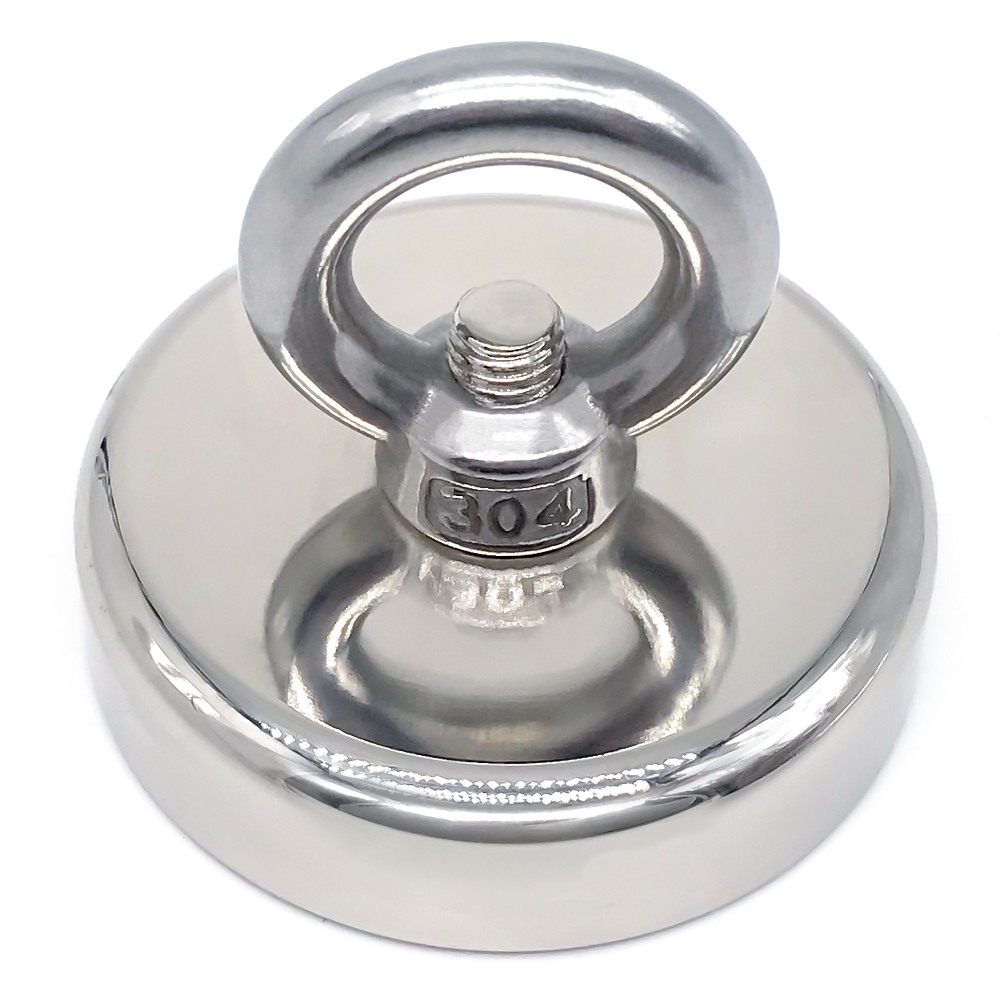
Underwater environments quickly destroy unprotected metals. Investing in high-quality materials ensures your gear lasts for years rather than weeks. You need to scrutinize how manufacturers protect their internal magnetic cores.
Neodymium oxidizes rapidly in water. It contains a high amount of iron. If exposed directly to moisture, the core rusts, swells, and eventually crumbles into powder. You must ensure the magnet specifies a Nickel-Copper-Nickel (Ni-Cu-Ni) triple-layer plating.
The first nickel layer protects against basic wear. The middle copper layer acts as an excellent binding agent. The final nickel layer provides a shiny, corrosion-resistant outer shell.
Implementation consideration requires active maintenance. Users must dry the equipment completely after every use to maintain this coating. Storing wet gear inside a plastic bucket accelerates unseen rust near the eyelet threads.
High-quality Fishing Magnets utilize a protective steel shell. Neodymium is incredibly brittle. It behaves more like ceramic than structural steel. The A36 or A3 steel casing protects this brittle core from shattering against underwater concrete pillars or jagged rocks.
Furthermore, the casing alters the physics of the tool. It actively focuses the magnetic field downward. Instead of letting magnetic energy bleed out the top and sides, the steel shell reflects it toward the exposed face. This intelligent design dramatically increases the direct pull force you experience in the field.
New enthusiasts often debate whether to build a custom rig or purchase a pre-assembled bundle. Both paths offer distinct advantages depending on your current experience level.
Buying standalone equipment works best for experienced hobbyists. You might want to upgrade to a stronger pull force. Perhaps you want to experiment with a specialized 360-degree model. If you already own highly reliable ropes and accessories, buying just the core unit saves money.
Kits offer excellent value for newcomers. However, cheap kits hide dangerous flaws. You must evaluate each component strictly.
Rope Quality: You need high-tensile strength nylon or paracord. It must measure at least 8mm thick. The breaking strength must significantly exceed the magnet's pull force. Using thin rope creates painful rope burn and risks snapping during heavy hauls.
Carabiners: Kits must include heavy-duty locking steel carabiners. Never accept cheap aluminum standard clips. Aluminum bends easily under the immense strain of a suctioned piece of underwater scrap.
Threadlocker (Essential): We emphasize the absolute necessity of medium or high-strength threadlocker (like Loctite 242) for the eyebolt. As your gear spins underwater on the rope, it generates torque. Risk warning: Unsecured eyebolts will unscrew underwater due to magnet rotation. You will pull up an empty rope.
Cut-Resistant Gloves: Proper hand protection remains necessary. You will constantly handle sharp, rusty finds. Gloves prevent severe cuts, reduce the risk of tetanus, and eliminate rope burn during heavy pulls.
You have learned the terminology. You understand the physics. Now, you need a systematic method to finalize your purchase. Follow this logical sequence to guarantee the best outcome.
Your local geography dictates your first major choice. Look at a map of where you plan to spend the most time.
Bridges and Piers: Choose Single-Sided models. You will drop them straight down. They provide the most concentrated lifting power for vertical pulls.
Banks and Shores: Choose Double-Sided models. You will throw them out and drag them back. They lay flat and cover more surface area across the mud.
Always match the pull force to the user's physical ability. Getting a massive 2,000 lb single-sided model sounds impressive. However, if you accidentally stick it to a steel bridge piling, can you pry it off? Most average adults cannot easily remove anything over 1,000 lbs from flat steel without specialized sliding wedges or mechanical leverage.
Trustworthy manufacturers provide transparent data. Look for transparency in their pull-force testing methods. They should explain how they arrived at their advertised numbers.
Ensure they clearly state the exact N-grade of the neodymium used. Avoid brands hiding behind vague terms like "super strong." Finally, reputable companies usually provide warranties against casing defects or internal chipping.
Finding the perfect gear does not need to feel like a gamble. The best setup always balances adequate pull force, a shape matching your specific environment, and high-quality protective coatings. Understanding these core principles separates successful outings from frustrating losses.
We highly recommend beginners start with an 800 lb double-sided kit. Ensure it includes a reliable threadlocker. This configuration offers manageable weight, excellent dragging capability, and safe handling. Always remember to secure your eyebolt properly. Finally, check your local waterway regulations before heading out, and prioritize your personal safety near deep water.
A: Beginners should choose a model with a 500-800 lbs combined pull force. This range offers plenty of strength to haul up relics and small scrap. More importantly, it ensures manageable weight for casting and drastically reduces severe pinch hazards during handling.
A: Neodymium retains its magnetism for decades. It loses less than 1% of its strength every ten years. However, exposure to extreme heat destroys the magnetic field. Additionally, if the outer coating chips, the internal core will rust and eventually crumble away.
A: Equipment loss usually occurs for two reasons. First, failing to apply liquid threadlocker allows the eyebolt to unscrew naturally as the rope twists underwater. Second, pulling a heavy rig into dense underwater tree branches or jagged rocks can wedge it permanently.
A: It depends on your environment. They are absolutely worth it for maximizing catch volume, as they attract metal from all directions. However, they lack a protective steel cup. We do not recommend them for highly rocky environments where they can easily chip or shatter.


