We are constantly trying to improve ourselves in new thoughts, new technology and new working methods.

Views: 0 Author: Site Editor Publish Time: 2026-11-25 Origin: Site


What hidden treasures lie concealed beneath fast-flowing river waters? The thrill of discovering forgotten historical artifacts or lost modern valuables at the bottom of a murky waterway captures the imagination of countless enthusiasts. River environments, however, pose dynamic and unique challenges compared to tranquil lakes or still ponds. Fast currents, jagged rocky beds, and unpredictable debris fields demand highly specialized equipment. Finding success ultimately comes down to choosing the right tool for the job. By understanding the nuances of design, magnetic flux, and mechanical setup, you can select the perfect equipment that suits a river search. This knowledge maximizes your underwater finds. More importantly, it minimizes the agonizing risk of losing your rig to a submerged snag.
Match the Magnet to the Technique: A Single Sided unit is engineered for vertical drops off bridges. Meanwhile, double-sided or 360-degree models provide superior performance for dragging along uneven riverbeds.
Prioritize Strength: River currents, mud, and thick silt act as physical barriers that weaken magnetic grip. Aiming for a higher capacity, targeting a minimum of 800 to 1,000 lbs combined, is essential for effective artifact retrieval.
Secure Your Setup: A properly fastened mechanical connection treated with an anaerobic threadlocker fluid is non-negotiable. This simple step prevents losing your equipment to unpredictable river snags.
Consider the Environment: Fast-moving rivers require heavier equipment to sink properly through the water column. Rocky bottoms demand snag-resistant, rounded designs to navigate the terrain safely.
Selecting the appropriate equipment requires a fundamental understanding of fluid dynamics. Unlike static bodies of water, rivers present dynamic hydrodynamic challenges. These forces directly impact how your equipment performs beneath the surface.
Flowing water exerts continuous kinetic force on any object dropped into it. Specifically, fast-moving water can easily sweep lightweight equipment downstream long before it ever makes contact with the riverbed. This hydrodynamic drag means that physical weight is just as critical as magnetic strength when operating in a river. Furthermore, riverbeds are rarely composed of flat, clean rock. They are typically smothered in thick layers of silt, mud, slippery algae, and loose cobble. These environmental factors create a physical barrier between the metal object and your equipment. Because magnetic force decays exponentially with distance, even a few millimeters of river mud can drastically reduce the holding power of your setup. Understanding these variables is the first critical step in successful Underwater Recovery.
Your primary operational technique should dictate your purchasing decision. Dropping involves vertical fishing from a stationary, elevated position like an old stone bridge, pier, or dock. The equipment is lowered straight down into deep water to target specific, localized areas. In contrast, dragging requires throwing the equipment out into the river and slowly pulling it back toward the shoreline across the rugged riverbed. Dropping relies on gravity and direct vertical contact. Dragging involves horizontal movement across highly uneven terrain. Consequently, each technique requires a drastically different magnetic field orientation to be successful.
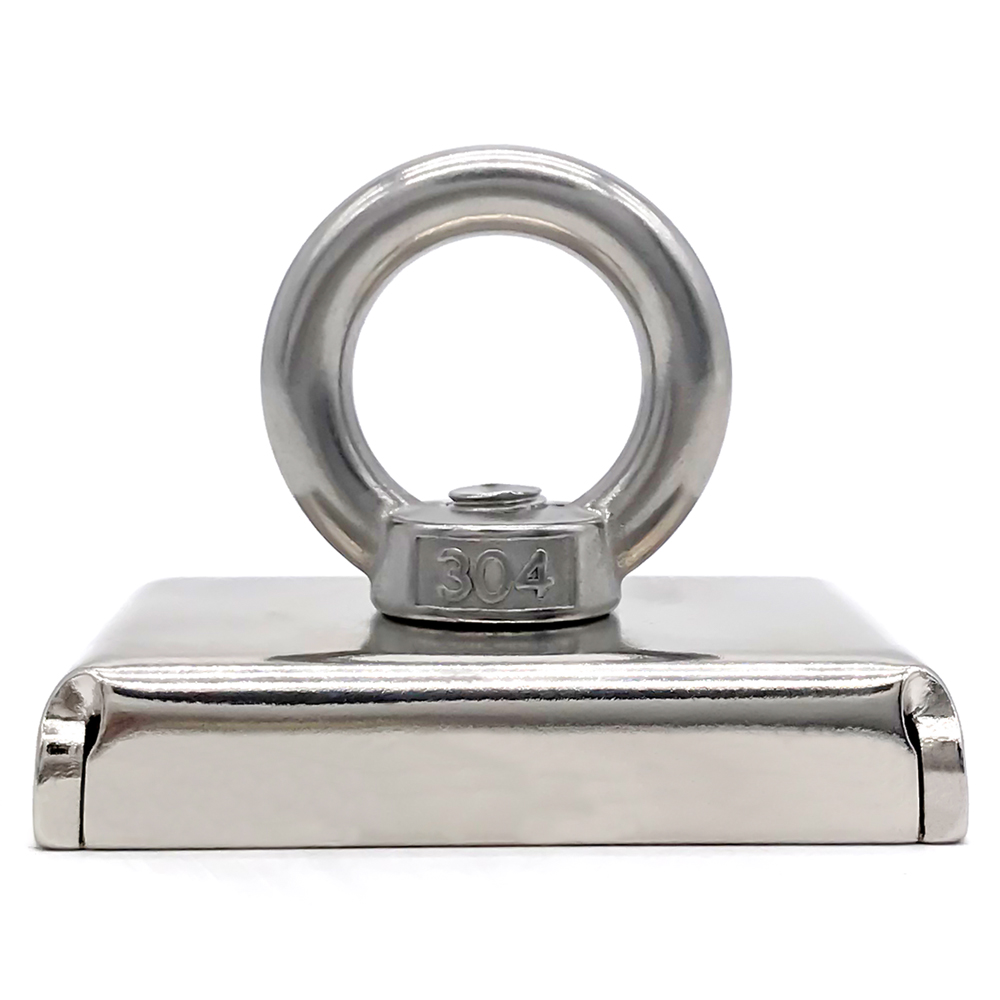
The physical shape and magnetic field orientation of your equipment will determine your success rate in varying river scenarios. To make an informed engineering decision, review the objective comparison of the three primary designs currently dominating the market.
Design Type | Optimal River Application | Hydrodynamic Drag | Mounting Configuration |
|---|---|---|---|
Single Sided | Vertical drops from bridges or piers | High | Top-mounted |
Double Sided | Dragging across uneven, muddy riverbeds | Moderate | Side-mounted |
360-Degree | Rocky, debris-heavy underwater terrain | Low | Center-axis |
This model features a solid steel casing, commonly known as a pot, that directs the entire magnetic field downward through a single exposed face. By concentrating the magnetic flux entirely on the bottom surface, this design offers the highest raw lifting power per square inch. It provides maximum strength for pulling heavy, dense objects straight up through the water column. For instance, it is highly effective for retrieving items like heavy safes, engine blocks, or discarded tools dropped directly below a pier. However, it remains generally poor for horizontal dragging. Because the mounting point is on top, pulling it across a riverbed often causes the unit to flip over. This drags the non-magnetic steel casing along the bottom, completely missing potential finds.
Double-sided models contain a magnetic core exposed on both the top and bottom faces, typically featuring a side-mounted attachment point. The magnetic force is split between two active surfaces. While the peak strength on one side might be lower than a single-sided model of the exact same total rating, the functional utility is effectively doubled. This configuration is widely considered the optimal choice for river dragging. Regardless of how the unit tumbles or lands on the riverbed, one active magnetic face is always pointing toward the mud. The side-mounted attachment keeps the unit flat as it is pulled horizontally, maximizing your strike zone.
The 360-degree model is a relatively modern innovation that lacks the restrictive steel casing. This allows the magnetic field to radiate in all directions simultaneously. Without the steel pot to focus the flux, the magnetic field is distributed radially. They are highly effective in uneven, rocky river terrains. As they roll, bounce, or tumble along the riverbed, they can attract metal from the sides, top, and bottom. On the downside, because the magnetic field is not concentrated, the direct vertical lifting capability is lower compared to shielded models. They are also more susceptible to physical chipping since the brittle neodymium material is fully exposed to jagged rocks.
Manufacturers advertise products based on peak pull force. However, this laboratory metric rarely translates directly to turbulent river conditions. Understanding this gap is critical. It sets realistic expectations and prevents catastrophic equipment failure during heavy lifts.
A Pull Rating is calculated under strict, controlled laboratory conditions. Engineers attach the unit to a solid, perfectly flat, unpainted plate of thick low-carbon steel. A machine then pulls the unit perfectly perpendicular to the surface until it breaks contact. In a turbulent river, you will almost never encounter these ideal conditions. A 1,000 lb rating does not imply that you can physically haul a 1,000 lb object out of a muddy river. It simply indicates the maximum theoretical holding force under pristine laboratory conditions.
Because environmental factors severely degrade magnetic grip, you must overcompensate. Selecting a higher capacity than you might initially think necessary is a standard engineering safeguard.
Beginners and Kids, 400 to 600 lbs: This range is safe and relatively easy to handle. It provides enough strength to recover small tools, lost fishing lures, and lightweight artifacts without posing a severe pinching hazard to inexperienced hands.
Intermediate or Standard River Search, 800 to 1,200 lbs: This tier offers the absolute best balance of power, weight, and manageability. A 1,200 lb double-sided unit provides enough localized force to grip through river silt while maintaining sufficient physical weight to sink rapidly in moderate currents.
Advanced Heavy Duty, 1,500+ lbs: Necessary for extracting massive items deeply embedded in river mud. These units are extremely heavy. They require meticulous handling to avoid serious injury or permanent, accidental attachment to structural bridge supports.
From an engineering standpoint, the magnetic flux circuit requires direct contact. Any air gap or non-magnetic barrier degrades the shear force exponentially. Most river finds, such as bicycle frames, old pipes, or firearms, are cylindrical. A flat magnetic face can only make tangential contact with a curved cylinder, reducing the effective grip area by over 80 percent. In addition, rust is non-magnetic and acts as a physical spacer. A thick layer of flaking iron oxide will easily break the magnetic circuit. Biofouling, including slimy algae and aquatic vegetation, creates a slippery barrier that prevents the crucial direct metal-to-metal contact required for a strong hold.
The most common, heartbreaking mistake beginners make is focusing entirely on magnetic strength while completely neglecting the mechanical connection. If your hardware fails, your prized equipment remains at the bottom of the river permanently.
The position of the hardware dictates the angle of leverage during retrieval. Top-mounted setups are standard on single-sided models. This configuration ensures the unit hangs perfectly flat, maximizing the surface area pointing downward. This is ideal for vertical drops from bridges. Conversely, side-mounted setups are standard on double-sided models. When tension is applied to the rope, the side mount forces the unit to lay flat against the riverbed. If a top mount were used for dragging, the unit would awkwardly tilt, lifting the active magnetic face away from the mud and rendering it useless.
You must never cast your equipment into a river without first securing the threads. As the rope twists and turns in the turbulent river current, it transfers immense rotational torque to the hardware. Without intervention, this twisting motion will systematically unscrew the Eyebolt, resulting in immediate and total equipment loss. To prevent this disaster, generously apply an anaerobic thread-locking fluid like blue Loctite 242 to the threads before initial assembly. Allow it to cure for a minimum of 24 hours. This creates a resilient chemical bond that resists vibration and rotational torque while remaining removable with hand tools if necessary.
Do not rely on standard hardware store twine or static climbing rope. The ideal rope must possess high tensile strength, minimal elasticity, and extreme abrasion resistance to survive dragging across sharp river rocks. Marine-grade braided nylon or heavy-duty paracord is highly recommended. These materials naturally resist rot and UV degradation. A minimum thickness of 8mm or 5/16 inch is advised. While thinner ropes might technically possess the necessary tensile strength, they are incredibly difficult to grip with wet hands and can cause severe friction burns under heavy loads. Thicker ropes provide a superior ergonomic grip when battling relentless river currents.
When preparing for a river search, the primary lifting tool is only one component of a broader recovery system. Empirical field data shows that relying solely on magnetic force in dynamic water conditions often leads to lost finds. To ensure a successful and safe operation, specific accessories are required to complement your primary setup.
A common misconception in the hobby is that high pull capacity can retrieve any heavy object independently. However, magnetic attraction is fundamentally different from a physical, mechanical hold. When you attach to a large, un-aerodynamic object like a submerged bicycle, shopping cart, or heavy safe, the hydrodynamic drag created by the flowing river current will constantly fight against your retrieval efforts. As you pull the object toward the surface, the water resistance often exceeds the shear force capacity of the magnet, causing it to slide off the metal surface. A stainless steel grappling hook acts as the necessary mechanical backup. Once your primary tool locates and grips a heavy item, you deploy the grappling hook to physically snare the frame or structure of the object. This dual-system approach ensures that the physical load is supported by the hook, allowing you to haul it up through fast currents without breaking the fragile magnetic bond.
Safety protocols are paramount in this activity. Rivers act as immense collection basins for decades of discarded industrial and recreational waste. The items you retrieve will frequently be covered in sharp rust, broken glass, jagged zebra mussels, and discarded fishing hooks. Furthermore, high-powered equipment possesses extraordinary snap-force. If a finger gets caught between the metal surface and the unit, the resulting pinch can cause severe lacerations or bone fractures. Heavy-duty, cut-resistant gloves coated in nitrile or latex are strictly necessary. They provide a vital barrier against tetanus-prone metals while offering a secure grip on wet, muddy ropes. Additionally, proper storage mitigates logistical risks. Transporting a high-powered unit in a vehicle without a dedicated non-magnetic case can result in it violently attaching to the vehicle's steel frame or disrupting sensitive electronics. A hard-shell case fitted with thick, high-density foam keeps the field safely contained.
Recent industry analyses and aquatic hobbyist trends highlight a significant shift in how enthusiasts approach river searches. Over the past few years, there has been a noticeable migration away from standard, single-purpose lifting tools toward highly specialized, multi-directional recovery systems. Market data indicates that modern hobbyists increasingly favor 360-degree and robust double-sided designs. This is largely driven by the need to navigate the complex, trash-heavy topography of urban rivers. Environmental awareness has also profoundly influenced gear manufacturing. There is a growing demand for eco-friendly, corrosion-resistant coatings, specifically triple-layer Ni-Cu-Ni plating, that prevent rare-earth element leakage into sensitive waterways. As municipalities increasingly recognize the environmental benefits of citizens removing scrap metal from local rivers, the industry is pivoting toward producing heavier, snag-resistant equipment specifically engineered to withstand the brutal hydrodynamic forces of fast-flowing currents. This evolution underscores a broader trend. Underwater recovery is maturing from a niche pastime into a sophisticated, gear-intensive environmental cleanup effort.
Selecting the optimal equipment requires matching the physical properties of your gear to the specific hydrological conditions of the river. There is no universally perfect tool. Rather, there are specialized instruments engineered for specific environments.
In environments characterized by high water velocity and depths under ten feet, hydrodynamic drag is your primary obstacle. A lightweight unit will simply be swept downstream before it can reach the riverbed. For these conditions, a heavy, double-sided model is the empirical choice. For example, selecting a robust D75mm or D90mm unit with an N52 neodymium core provides the sheer mass needed to combat the current and sink rapidly to the bottom. Because the retrieval technique in shallow rivers primarily involves throwing and dragging, the double-sided design ensures that regardless of how it lands or rolls along the rocky bottom, one active face is always directed toward the riverbed.
Conversely, deep rivers with minimal current require a distinctly different approach. These are often searched vertically from elevated structures like bridges, piers, or retaining walls. In these scenarios, you are not dragging across a wide area. You are executing targeted, vertical drops. The most effective tool for this specific environment is a high-capacity single-sided model. By dropping vertically, you bypass the need for horizontal dragging, efficiently pulling dense, heavy objects straight up through deep water.
The structural integrity of your equipment dictates the overarching success of your operations. Low-grade products often suffer from poor plating, leading to rapid corrosion when exposed to river water. Inferior thread machining can result in catastrophic hardware failure during a heavy lift. When sourcing industrial-grade neodymium, it is advisable to consult specialized suppliers who engineer their products specifically for harsh aquatic environments. For a comprehensive selection of durable, high-capacity equipment tailored to river searches, practitioners can explore a dedicated Fishing Magnet catalog. Prioritizing verified suppliers ensures that the advertised pull ratings align with actual field performance, providing the unwavering reliability required for serious recovery efforts.
Executing a successful recovery operation requires methodical planning and strict adherence to established best practices. Transitioning from theoretical knowledge to practical application involves careful site selection, precise casting techniques, and unwavering environmental compliance.
The yield of your search is directly correlated to the historical and contemporary usage of the location. Randomly casting into a remote, untouched section of a river rarely produces significant results. Instead, focus on areas with high human traffic over extended periods. Optimal locations include old stone bridges, historical ferry crossings, urban riverwalks, and popular fishing piers. Bridges, in particular, are historical hotspots. For centuries, people have dropped, lost, or intentionally discarded items over bridge railings. Before visiting a site, cross-reference local historical maps with modern satellite imagery to identify infrastructure that has existed for decades.
The mechanics of casting and retrieving dictate how effectively your gear interacts with the riverbed. Stand with a wide, stable base. Before casting, ensure the rope is neatly coiled on the ground beside you, free of tangles. Never wrap the retrieval rope around your wrist or hand. If the equipment snags on a moving object, such as a passing boat or heavy floating debris, it can cause severe injury. Utilize a smooth, underhand toss rather than an erratic overhand throw. An underhand motion provides better trajectory control and ensures the unit lands flat, significantly reducing the risk of it tumbling and snagging on submerged branches. Patience is critical during retrieval. Pull the rope back at a slow, deliberate pace. If you retrieve it too quickly, the hydrodynamic lift will cause it to hydroplane and bounce along the bottom, breaking the magnetic field's reach and completely missing dense metallic objects buried in the silt.
Practitioners of this hobby act as informal custodians of the waterways. The fundamental rule of river recovery is to pack out everything you extract. Rivers contain vast amounts of scrap metal, including rusted nails, degraded wire, and unrecognizable iron fragments. If you pull these items out of the water, it is your strict environmental responsibility to dispose of them properly. Throwing scrap metal back into the river or leaving it on the riverbank poses a severe hazard to wildlife, swimmers, and local infrastructure. Carry a durable bucket for scrap, and transport your finds to a local recycling facility. Adhering to these ethical standards ensures the hobby remains sustainable and viewed positively by local authorities.
Ultimately, choosing the right equipment depends entirely on your specific river conditions and chosen techniques. While a double-sided model with a secured mechanical setup usually serves as the most versatile option for dragging, deep-water drops demand the concentrated power of a single-sided design. Always prioritize a high capacity rating to counteract the inevitable grip loss caused by river silt, rust, and fast currents. Before heading out, meticulously check your gear, ensure your threads are locked tight, and prepare your safety accessories. Magnet fishing is an incredible way to actively clean up local waterways while experiencing the palpable thrill of unearthing hidden history. Ready to upgrade your recovery arsenal? Explore the professional-grade catalog at Shine Magnetics to find the perfect match for your next river expedition, and uncover the forgotten treasures waiting beneath the surface safely.
For novice practitioners, a double-sided model with a combined rating of 600 to 800 lbs is generally the most practical and safest choice. This specification offers sufficient force to retrieve interesting artifacts without being so overwhelmingly powerful that it becomes permanently affixed to heavy underwater infrastructure, such as bridge pilings or submerged I-beams. A double-sided design is also much more forgiving for beginners learning the nuances of dragging the riverbed, as it guarantees an active face is always engaged regardless of how it lands in the water.
Neodymium, the rare-earth element used in these specialized tools, degrades at an exceptionally slow rate. It typically loses less than 1 percent of its raw strength over a ten-year period under normal conditions. However, the effective capacity can be drastically reduced by physical damage and harsh environmental factors. If the protective Nickel-Copper-Nickel coating is chipped by violently striking river rocks, the exposed neodymium will rapidly oxidize and rust in the water. Severe corrosion quickly degrades the structural integrity, permanently ruining its effectiveness. Therefore, proper rinsing and thorough drying after each use are absolutely required to maintain longevity.
If your equipment becomes attached to an immovable underwater object, applying brute linear force is rarely effective and will likely damage your rope or strain your back. Instead, utilize a sliding or shearing technique. Pull the rope firmly from a sharp lateral angle to break the direct hold. If it is stuck to a flat, accessible surface above the water, carefully insert a non-magnetic plastic wedge or a wooden pry bar between the metal surface and the unit to break the bond. Under no circumstances should you tie the rope to a vehicle to pull it free, as the extreme tension can cause the heavy metal to become a lethal projectile if it suddenly detaches.
Empirical testing demonstrates that single-sided models are highly inefficient for dragging applications. Because the attachment point is mounted on the top center, horizontal tension from the rope naturally causes the unit to tip forward. Consequently, it drags on its non-magnetic side or edge, directing the active field away from the riverbed. This awkward positioning results in a significantly reduced catch rate. Single-sided models should be strictly reserved for vertical dropping scenarios where they can descend cleanly and sit perfectly flat against the target.
Standard nylon ropes or hardware store twine are insufficient for river recovery. The ideal choice is a marine-grade double-braided nylon or heavy-duty paracord with a minimum diameter of 8mm. These materials offer exceptional tensile strength, resist UV degradation, and withstand the severe abrasion caused by dragging across jagged river rocks. Thicker ropes also provide a crucial ergonomic advantage, allowing you to maintain a firm grip with wet hands when battling heavy currents.
Maintenance is critical for preserving the integrity of the Ni-Cu-Ni coating. After every river trip, thoroughly rinse the unit with fresh water to remove corrosive minerals, abrasive silt, and organic debris. Use a plastic scraper or a stiff-bristled non-metallic brush to clear away stubborn magnetic sand and iron shavings. Once clean, dry the equipment completely with a microfiber cloth. Applying a light coat of WD-40 or a specialized anti-rust oil before storing it in a dry, padded case will significantly extend its operational lifespan.


