We are constantly trying to improve ourselves in new thoughts, new technology and new working methods.

Views: 0 Author: Site Editor Publish Time: 2026-08-10 Origin: Site


A stuck fishing magnet is usually a problem of angle, obstruction, or an exceptionally good contact with ferrous metal. The wrong response is to pull harder without a plan. Sudden force can damage the rope, pinch hands, shift a heavy object unexpectedly, or tighten the magnet into a worse snag. Start by keeping people clear of the tension line, assessing what the rope is doing, and changing the direction of pull. If the magnet cannot be freed with controlled efforts, preserving personal safety is more important than recovering the equipment.
Stop yanking as soon as the magnet will not move normally.
Keep hands and feet away from a tensioned rope and from the likely release path.
Change the pull angle gradually; a sideways or upward pull often breaks a magnetic hold.
Distinguish a magnetic attachment from a rope snag before applying force.
Leave the magnet in place when the situation creates a serious safety, access, or legal concern.
The magnet may be attached flat to a large steel object, lodged beneath an edge, wrapped around a submerged obstacle, or held by an object that is buried in mud. These situations need different responses. A flat attachment has strong direct contact. A snag may not be magnetic at all; the rope can be trapped around timber, cable, rebar, rock, or debris. Mud suction and entanglement add resistance even when the object is not large.
Do not assume the pull-force rating tells you what to do. Rated holding force is normally measured under controlled conditions and does not describe a tangled rope, an unknown object, or an awkward pulling direction. The goal is to reduce the force holding the assembly, not to turn the rope into a lever.
Use a methodical sequence and pause after each change. Keep bystanders outside the line of pull.
Stop and secure your footing. Put on gloves if they are not already in use.
Take up slack slowly and note whether the rope leads straight down, along the bottom, or around an obstruction.
Walk several steps to either side and pull steadily, not sharply, to change the release angle.
If possible, move closer to create a more vertical lift, then try a small sideways change again.
Alternate gentle tension and controlled slack; this can let the magnet rotate or disengage from an edge.
If the line may be wrapped, trace its direction from a safe position rather than continuing to load it.
Never wrap the rope around your hand, wrist, waist, vehicle, or a fixed structure to multiply force. A release can occur suddenly, and the recoil or moving object can cause injury. Avoid using a vehicle or winch unless the complete setup, load path, anchor, access permissions, and safety controls have been evaluated for that purpose.
A fishing magnet holds most strongly when its face is flat against clean steel. Pulling straight away from that face requires more force than sliding or peeling it away from an edge. This is why changing position is often the most useful first action. Walk upstream or downstream, move around the dock, or approach from a different bank position if it is safe and lawful to do so.
Situation | Safer first response | Avoid |
Magnet on a flat steel surface | Pull from a new side to create a peel angle | Straight, repeated jerks |
Rope runs under an obstacle | Add slack and reposition to trace the line | Pulling until the rope cuts or frays |
Object seems buried | Use slow alternating tension and slack | Shock-loading the assembly |
Unknown large object | Stop and evaluate access and hazards | Attempting a blind heavy lift |
Magnet near boats, cables, or structures | Notify the responsible party or leave it | Damaging property to recover gear |
The Shine fishing-magnet selection includes designs with different recovery faces and eye configurations. Correct attachment and an appropriate rope are part of the system; a strong magnetic assembly does not eliminate the need to plan for release.
Rope snags deserve special caution because the visible line can hide the real path underwater. Feed out a small amount of slack, then retrieve slowly from a different direction. This may unhook a loop from a branch, railing, rock, or bottom feature. If the rope feels rough, changes angle suddenly, or will not move after repositioning, stop. Continuing to pull can abrade the rope until it fails.
Inspect the rope after any successful release. Look especially near the knot, connector, and section that passed over an edge. Fraying, flattened braid, melted fibres, deep cuts, or stiffness are reasons to remove the rope from service. A damaged rope may hold during a light test but fail during the next heavy recovery.
Some situations should not be solved at the water’s edge. Stop if the object could be an unexploded device, weapon, evidence, hazardous container, electrical equipment, fuel-related debris, or property that should not be disturbed. Keep people away and contact the relevant local authority or site owner when appropriate. Do not attempt to identify or transport suspicious objects yourself.
Stop also when the recovery would pull against a bridge, boat, pier, utility structure, private property, or a steep unstable bank. Leaving equipment is frustrating, but a controlled loss is preferable to an injury or property damage. If a fishing magnet is abandoned, document the location safely and avoid creating a hazard for other water users.
Prevention begins with site choice and controlled retrieval. Avoid blind dragging through dense scrap, around bridge infrastructure, boat moorings, utility crossings, and places where the rope may pass behind hidden geometry. Work a zone gradually rather than throwing far beyond the area you can approach from multiple angles.
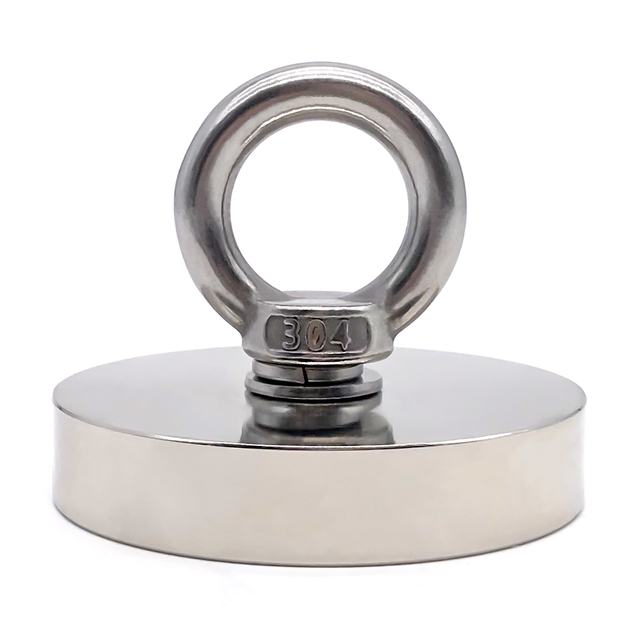
Before use, check the threaded attachment, rope knot or connector, and any swivel or ring. A double-sided neodymium fishing magnet can support broad search patterns, but broad coverage also means more chances to meet edges and debris. Use a rope with a condition and rating appropriate to the intended retrieval work, and replace it before visible damage becomes a failure.
Ningbo Shine Magnetic Technology Co., Ltd. supplies fishing magnets for retrieval applications. Buyers should consider release planning as a selection criterion: eye hardware, attachment direction, housing shape, rope interface, intended water depth, and likely obstacles should be discussed alongside magnetic force.
When a fishing magnet gets stuck, slow down and change the geometry of the problem. Keep clear of the tension line, distinguish a magnetic hold from a rope snag, and use controlled changes of angle rather than repeated hard pulls. Inspect the rope after release and stop whenever the object, location, or load path creates uncertainty. Strong recovery equipment is useful, but safe judgement is what prevents a stuck magnet from becoming an accident.
Move to a new position and pull gradually at a sideways or peeling angle. Avoid sharp jerks and keep people clear in case the magnet releases suddenly.
Do not use a vehicle as an improvised recovery method. It can overload rope, damage property, and create a dangerous release path.
It may be contacting large steel surfaces, catching under edges, or dragging through locations with submerged debris and rope traps.
Only as a last resort after you have moved people to safety and considered the environmental and access implications. Never cut a rope while it is highly tensioned.
Inspect the rope, knot or connector, eye bolt, housing, and magnetic face for cuts, looseness, chips, or impact damage before continuing.


