We are constantly trying to improve ourselves in new thoughts, new technology and new working methods.

Views: 0 Author: Site Editor Publish Time: 2026-06-21 Origin: Site


Engineering heavy-duty magnetic mounts presents a unique set of challenges. Designers must secure substantial payloads firmly without risking structural failure. They also need to avoid relying on protruding hardware. Bare magnets are inherently brittle and crack easily under mechanical stress. They complicate fixture integration and often result in inefficient space utilization. You need a flush-mounting component resilient enough to withstand repetitive impact. Enter the Countersunk Pot Magnet. This engineered assembly stands as the definitive solution for high-stress applications. It skillfully combines the magnetic field manipulation of a durable steel cup alongside the mechanical stability of a standard countersunk screw. By channeling magnetic energy to a single active face, you maximize pull force while safeguarding the fragile core. This guide explores the distinct advantages, critical material considerations, and strict installation protocols necessary to integrate these components effectively into your next commercial or industrial build.
Performance Amplification: The steel cup redirects the magnetic field to a single active face, significantly increasing vertical holding force compared to standard magnets.
Durability: The housing protects the brittle magnetic material from impact and structural degradation.
Installation Risk: Over-torquing or using incorrect screw profiles (e.g., mismatched angles) is the leading cause of magnet fracture; strict installation protocols are required.
Selection Criteria: Specifying the correct magnet requires evaluating operating temperature, environmental exposure, and the difference between direct pull and shear force requirements.
Let us explore magnetic circuit optimization first. The steel housing drastically alters the standard magnetic circuit. Unlike raw magnets projecting fields in all directions, the steel cup redirects magnetic energy. It focuses this energy exclusively on the single open face. This redirection amplifies the overall pull force immensely. You achieve superior clamping performance from a comparatively small footprint. For engineers seeking maximum structural efficiency, Pot Magnets deliver unmatched utility.
Flush mounting capabilities add another massive layer of value. The countersunk hole accommodates standard flat-head screws perfectly. When fastened properly, the screw head sits entirely below or flush within the magnetic surface. This creates a zero-profile surface. A completely flat mating area is critical for moving machine parts. It also matters greatly for sliding closures or any assembly requiring extremely tight mechanical tolerances. You eliminate dangerous snagging hazards completely.
Impact resistance forms the third major mechanical advantage. Bare neodymium is notoriously fragile. Dropping a raw magnet usually causes immediate chipping. Allowing it to snap abruptly onto metal yields similar catastrophic results. The steel shell completely changes this dynamic. It structurally reinforces the internal magnetic core. The housing absorbs the blunt force during repetitive mechanical contact. This essential protection prevents structural degradation over thousands of operational cycles. You gain a robust, industrial-grade fixture instead of a delicate component.
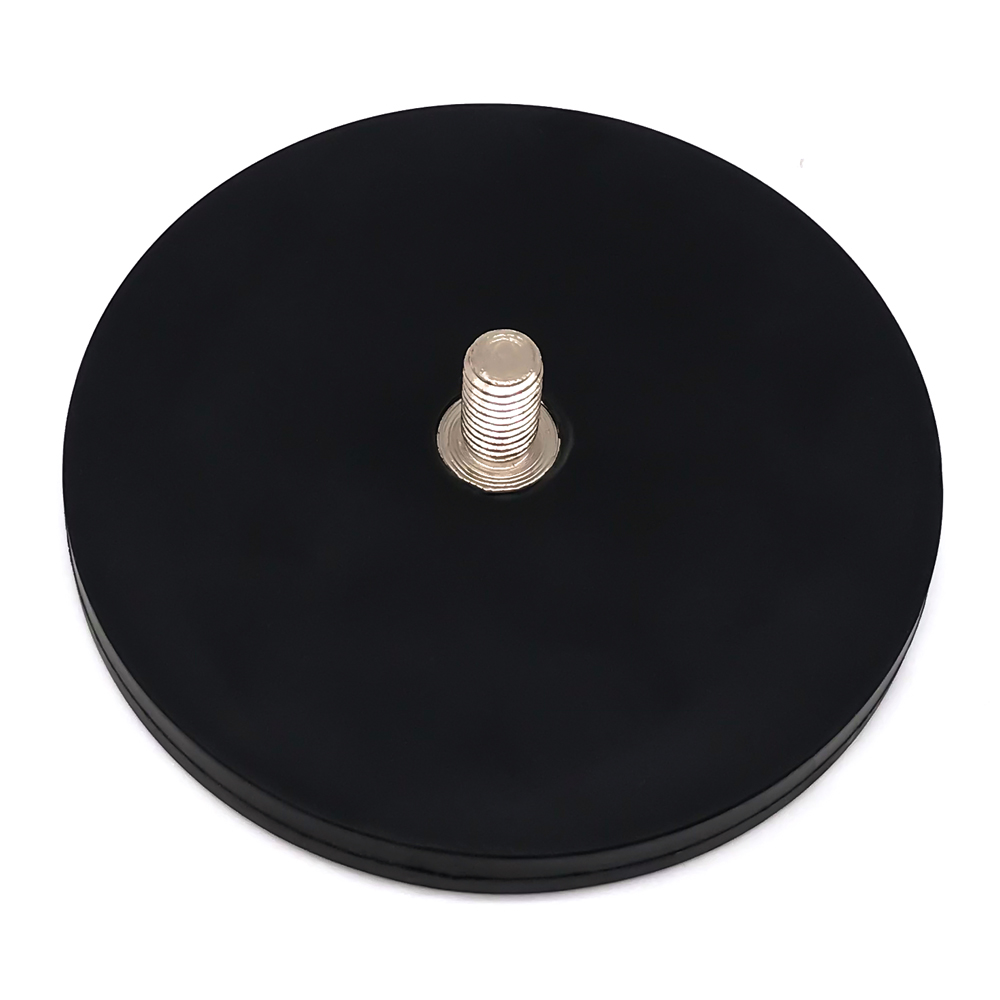
You must compare Neodymium (NdFeB) and Ferrite options carefully. Material selection dictates overall performance and environmental longevity. Neodymium provides maximum holding force within a highly compact footprint. Engineers prefer it for space-constrained industrial fixtures. However, neodymium easily corrodes when exposed to moisture. It requires triple plating (Ni-Cu-Ni) for adequate environmental protection. You must keep it dry unless you specify a fully sealed housing.
Ferrite or ceramic options offer a highly cost-effective alternative. They are exceptionally corrosion-resistant by nature. They excel in outdoor applications or high-temperature environments. Choose ferrite when your holding force requirements remain moderate and environmental exposure is high.
Let us look at sizing and pull force realities next. Manufacturers publish specific "rated pull force" data. You must interpret these numbers cautiously. The laboratory rating assumes highly specific, ideal conditions. It assumes you attach the magnet to a thick, unpainted, perfectly flat steel target. Real-world commercial applications rarely match this strict ideal.
You need a decision framework for derating pull force. Air gaps dramatically reduce magnetic attraction. Even thin powder coating layers compromise performance. Alloy composition also matters significantly. High-carbon steel or cast iron yields lower pull forces than standard mild steel. Surface thickness plays a massive role too. If your target metal is thinner than the magnet itself, it reaches magnetic saturation quickly. The unabsorbed magnetic field passes right through the metal. You lose significant holding power instantly.
Material Type | Relative Pull Force | Corrosion Resistance | Max Operating Temp (Standard) | Best Use Case |
|---|---|---|---|---|
Neodymium (NdFeB) | Extremely High | Low (Requires Plating) | 80°C (176°F) | Compact, heavy-duty indoor fixtures. |
Ferrite (Ceramic) | Moderate | Very High | 250°C (482°F) | Outdoor displays, high-heat environments. |
Samarium Cobalt (SmCo) | High | High | 300°C (572°F) | Extreme temperature industrial equipment. |
Let us break down exactly where these engineered components excel. They solve specific problems across multiple demanding industries.
Jigs, Fixtures, and Tooling: Machinists require absolutely reliable work-holding solutions. Flush surfaces are practically mandatory here. Protruding hardware causes catastrophic interference during machining. It disrupts tooling paths and ruins expensive CNC equipment. A flush magnet secures workpieces firmly. It maintains a clean, predictable clearance profile for cutting tools.
Architectural and POS Displays: Retail environments demand clean aesthetics. Installers use heavy-duty signage and adjustable shelving constantly. These environments require rapid, tool-free deployment. Concealed magnetic mounts provide reliable strength. They allow swift reconfiguration of Point of Sale (POS) displays without damaging store fixtures.
Cabinetry and Industrial Closures: Heavy doors need exceptionally strong latches. Access panels on industrial machinery face high vibration daily. Standard mechanical latches wear out or rattle loose over time. Magnetic closures maintain high tension continually. They endure thousands of open-close cycles without any mechanical degradation.
Success criteria dictate careful, proactive planning. Successful application hinges entirely on matching the magnet's pull rating to the specific payload. You must consider the operational environment closely. Evaluate the exact weight of your doors or signs. Account for the physical leverage acting against the magnetic bond. Will the assembly endure constant vibrations? A heavier payload demands a larger magnetic surface area. Never specify a mount based purely on the best-case laboratory rating. You must over-engineer the holding force to guarantee safety.
Installing brittle magnetic materials requires strict adherence to protocols. Common mistakes lead directly to shattered components and expensive project delays. Follow these expert installation tips closely to ensure success.
Matching Screw Profiles: You must specify the exact correct screw head angle. Standard hardware countersinks typically measure 82° or 90°. The screw profile must precisely match the magnet’s countersink angle. A mismatched angle concentrates extreme pressure on a tiny rim of the brittle magnetic material. This uneven pressure distribution almost guarantees immediate fracture upon tightening.
Torque Control: Over-tightening remains the primary cause of catastrophic failure. The internal magnetic ring remains highly sensitive to compressive force. We highly recommend simple hand-tightening for all installations. If you must use power tools, dial in the lowest possible low-torque clutch settings. Stop driving the screw the precise moment it sits flush. Prevent the brittle magnet material from shattering inside its protective steel cup.
Hardware Selection: Fastener hardware alloy matters greatly during assembly. Advise your assembly team to use entirely non-magnetic screws. Excellent choices include 300-series stainless steel or solid brass. Magnetic steel screws jump violently toward the magnet during installation. This makes precision alignment incredibly frustrating. Non-magnetic fasteners also help maintain predictable magnetic field distribution across the active face.
Surface Preparation: Your mating surface ultimately dictates installation success. Outline clear surface preparation requirements for your assembly team. The mounting surface must be exceptionally clean, completely flat, and fully deburred. Any small debris or burr forces the cup to sit unevenly. Tightening a screw over uneven terrain flexes the steel housing. This tiny flex transfers stress directly into the ceramic core. It causes the core to crack instantly. Maximize magnetic contact through proper prep.
Defining your operating environment is your vital first procurement step. Create a strict checklist evaluating environmental exposure. Evaluate the maximum operating temperatures your specific assembly will face. Standard neodymium loses magnetism permanently around 80°C (176°F). If your application exceeds this limit, you must specify high-temp Neodymium variants. For extreme industrial heat, Samarium Cobalt is absolutely required. Next, evaluate moisture exposure. If the environment stays wet, select fully encapsulated models or resilient ferrite alternatives.
Evaluating shear versus direct pull is equally critical. Direct pull measures the exact force required to pull the magnet straight off a surface. Shear force measures vertical sliding resistance. Engineers often overlook this critical performance distinction. Shear force is typically only 15-20% of the rated direct pull force. If you mount a heavy sign vertically, gravity acts entirely in shear. The sign will slide down the painted wall long before it pulls directly off. You must introduce friction-enhancing solutions if shear force forms the primary load. You can specify rubber-coated variants. Alternatively, you can design physical ledges into the fixture to bear the gravitational weight.
Table: Theoretical Pull Force Derating Framework | ||
Condition Variable | Impact on Rated Pull Force | Recommended Action |
|---|---|---|
Direct Pull (Ideal Conditions) | 100% of Rated Force | Standard baseline for calculations. |
Vertical Mount (Shear Force) | Reduces force by 80% to 85% | Add rubber backing or physical support ledges. |
Thin Steel Target (< 2mm) | Reduces force by 40% to 60% | Use a larger diameter magnet to spread flux lines. |
Thick Paint / Powder Coating | Reduces force by 30% to 70% | Test in situ; upsize magnet pull rating significantly. |
Let us discuss actionable next steps for buyers. Procurement teams should always request physical samples. Conduct rigorous prototype testing before committing to bulk procurement. Theoretical holding force rarely matches real-world application perfectly. Test the specific magnets on the exact materials you plan to use. Measure performance through actual paint layers. By prototyping early, you ensure the theoretical specifications translate safely and effectively to your final product assembly.
These specialized flush mounts offer an unmatched combination of benefits. They deliver precise flush-mounting capabilities, essential mechanical protection, and highly concentrated holding power. They effectively resolve complex engineering challenges where traditional fasteners fall short. They keep surfaces entirely flat while bearing substantial physical weight securely.
We offer a final recommendation for your engineering team. We strongly encourage engineers and procurement managers to test these mounts in situ. You must always account for real-world variables. Measure the exact paint thickness on your enclosures. Calculate the actual shear loads acting on your vertical assemblies. Never rely solely on a laboratory datasheet for mission-critical builds.
Take action today to secure your structural designs. Consult with a dedicated magnetic engineering specialist to review your unique project parameters. Review technical datasheets closely to match material specifications directly with your operating environment. Request a sample kit today. Evaluate the performance firsthand and engineer your next fixture with total confidence.
A: This is usually caused by over-torquing the fastening screw. Another common culprit is using a screw head that does not sit perfectly flush with the specific countersink angle. Finally, mounting the housing on an uneven surface causes flexing, which shatters the internal material instantly.
A: Yes, you physically can, but we highly recommend non-magnetic screws. Using 300-series stainless steel or brass makes installation significantly easier. It prevents the screw from jumping to the magnet mid-installation and avoids unintended magnetic interference at the active face.
A: It affects it drastically due to the "air gap" principle. Magnetic strength drops exponentially as distance increases. Even a fraction of a millimeter of paint or powder coating can significantly reduce the effective pull force of your assembly.
A: Yes, it heavily influences the field shape. The steel cup concentrates the magnetic field at the immediate surface. This drastically increases the direct pull force on contact. However, it significantly reduces the distance the magnetic field projects outward, resulting in a much shallower reach.


