We are constantly trying to improve ourselves in new thoughts, new technology and new working methods.

Views: 0 Author: Site Editor Publish Time: 2026-08-16 Origin: Site


Industrial magnet procurement often feels like a difficult balancing act. You must weigh strict magnetic strength requirements against tightening budget constraints and volatile supply chains. Selecting the wrong material can derail your entire production line. Ferrite Magnets are ceramic compounds made from iron oxide mixed with strontium or barium. They are not a budget compromise. Instead, they serve as a strategic engineering choice for specific environmental and financial parameters. This guide outlines exactly where these materials succeed and where they fail. We will show you how to evaluate them effectively for your next production run. You will learn the exact trade-offs required to optimize your magnetic assemblies.
Cost-to-Volume Efficiency: Ferrite magnets offer the lowest cost per unit of magnetic energy, making them the standard for high-volume, cost-sensitive applications.
Environmental Resilience: Inherent resistance to corrosion and demagnetization eliminates the need for expensive surface platings.
Key Trade-offs: Their lower magnetic output requires larger volume to match rare-earth magnets, and their brittle ceramic nature requires careful handling during assembly.
Primary Deployments: Dominant in automotive DC motors, magnetic separation equipment, and heavy-duty holding assemblies.
Engineers consistently choose ceramic magnetic materials to solve complex manufacturing bottlenecks. Choosing the right magnetic solution requires looking beyond sheer power. You must evaluate macro-level success criteria, material abundance, and environmental hardiness.
Rare-earth materials face intense geopolitical pricing volatility. Neodymium pricing can spike unpredictably due to restricted mining operations and complex refining processes. You avoid this instability entirely when you choose ceramic alternatives. These materials rely on highly abundant iron oxide. Supply chains remain stable globally across various regions. This predictable availability makes long-term production planning much easier. Procurement officers can lock in pricing for multi-year contracts without fearing sudden material shortages.
Lower raw material costs drive high-volume adoption across the manufacturing sector. Ceramic materials require zero surface plating to function properly. You do not need expensive nickel-copper-nickel layers to protect them. This structural simplicity drastically reduces your overall unit cost. Manufacturers save significant capital on secondary processing steps. When you produce millions of automotive components, these incremental savings scale into massive budget efficiencies.
Industrial environments degrade sensitive components rapidly. Moisture, abrasive dust, and harsh chemicals destroy unplated metals. Ceramic magnets feature intrinsic corrosion resistance. They thrive in fully exposed industrial conditions. They also offer excellent thermal stability for heavy-duty operations. You can operate them safely at elevated temperatures up to 250°C. Standard rare-earth magnets often suffer irreversible magnetic loss at these temperatures. This thermal endurance keeps heavy machinery running smoothly during peak loads.
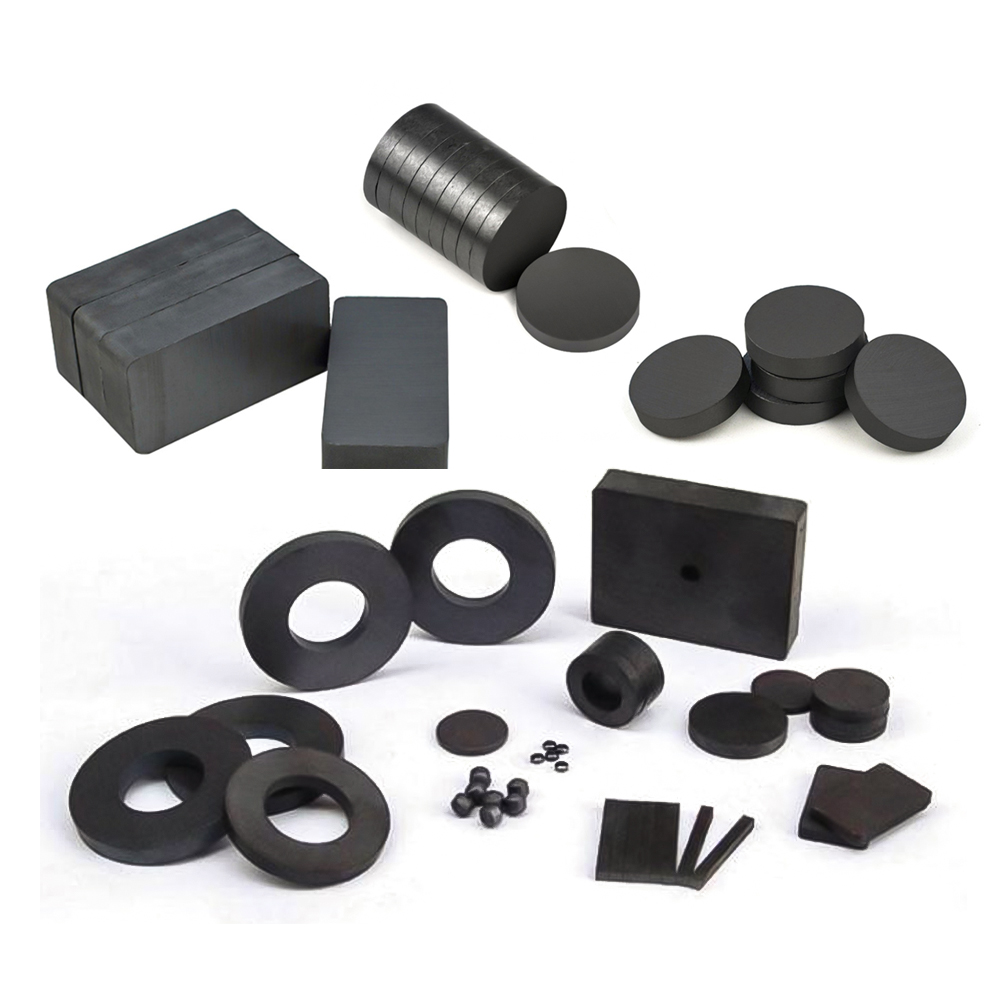
Different materials solve different operational challenges. You must map the magnetic material to your specific solution category. Here is how leading industries deploy these materials to achieve specific operational outcomes.
Stators and rotors use these components extensively. Automotive designers rely on them for windshield wipers, window regulators, and seat adjustments. HVAC blowers and household appliance pumps also deploy them widely.
Operational Outcome: They deliver cost-effective continuous rotation. They work best in environments where motor size and weight are not strictly limited.
Best Practice: Use anisotropic grades for motors to maximize radial magnetic flux.
Mining operations install heavy overband magnets and grate magnets over conveyor belts. Food processing plants and recycling facilities depend on magnetic pulleys to ensure product purity.
Operational Outcome: These systems extract tramp iron reliably. High-abrasion and high-moisture environments do not degrade their performance.
Common Mistake: Failing to clean grate magnets regularly reduces their effective capture range.
Heavy industry requires immense and reliable holding power. Industrial sweepers and scrap yard lifting assemblies use these components. Workholding chucks in steel fabrication rely on them heavily to secure raw materials.
Operational Outcome: They project deep magnetic fields. You get consistent holding force across significant air gaps.
Best Practice: Encapsulate the brittle magnetic core in a steel U-channel to protect it from impact.
Public address systems use heavy-duty speakers equipped with large magnetic rings. Manufacturing lines use industrial proximity sensors to monitor assembly stages.
Operational Outcome: These ceramic materials ensure highly stable performance. They survive decades of continuous vibration and daily operational stress.
Application Category | Typical Components | Primary Advantage |
|---|---|---|
Automotive Motors | Stators, Rotors, DC Motors | Low unit cost for high-volume production |
Material Sorting | Overband Magnets, Pulleys | Corrosion resistance in harsh conditions |
Heavy Lifting | Magnetic Chucks, Sweepers | Deep magnetic field penetration |
Acoustics | PA Speakers, Proximity Sensors | Long-term stability against vibration |
Engineers often debate between ceramic and rare-earth materials. You need a clear, unbiased comparison to shortlist the right material. This evaluation framework highlights the physical and chemical differences driving modern engineering decisions.
We must address the primary limitation head-on. Neodymium produces roughly ten times the magnetic energy of ceramic equivalents. This density gap forces a critical design choice. Follow this simple rule of thumb during the drafting phase. If physical space and component weight are strictly constrained, you must use NdFeB. If your design offers ample space, ceramic is the smarter economical choice. You can simply use a larger volume of material to achieve the required magnetic force.
Heat affects different magnetic materials in opposing ways. Intrinsic coercivity in ceramic compounds actually increases as they get hotter. This phenomenon continues up to a specific operational limit. Because of this trait, they resist demagnetization much better than standard NdFeB grades at elevated temperatures. High-speed motors generate intense friction and ambient heat. Ceramic options maintain their integrity during these thermal spikes.
Food-grade applications enforce strict hygiene and safety standards. Submerged fluid pumps require completely rust-proof components. Industrial Ferrite Magnets sit in a natural oxidation state. They simply cannot rust any further. This unique chemical characteristic streamlines FDA and sanitation compliance dramatically. Coated NdFeB parts always carry the risk of plating failure. A scratched rare-earth magnet will rust and fail. Ceramic materials eliminate this compliance risk entirely.
Evaluation Metric | Ferrite (Ceramic) | Neodymium (NdFeB) |
|---|---|---|
Magnetic Energy (BHmax) | Low (approx. 1-4 MGOe) | High (approx. 33-52 MGOe) |
Maximum Operating Temp | Up to 250°C | Typically 80°C - 150°C |
Corrosion Resistance | Excellent (Inherent) | Poor (Requires Plating) |
Cost per Unit Volume | Very Low | High |
Trustworthy engineering requires transparent acknowledgment of material downsides. You must understand these implementation risks before locking in your final product design. Failing to account for these limitations causes severe assembly line failures.
You must account for the physical fragility of the material. Chipping and cracking occur frequently. Automated assembly lines often subject components to sudden physical impacts. High-impact applications easily shatter raw ceramic. We strongly recommend using proper housing and encasing techniques. Surrounding the magnet in a protective steel or plastic shell absorbs mechanical shock. Never use these raw materials as structural load-bearing elements in your assembly.
Manufacturers create these parts through a pressing and sintering process. Custom shapes require expensive custom die tooling. This upfront requirement makes low-volume custom prototyping cost-prohibitive. Machining other materials is usually cheaper for initial proof-of-concept testing. Once you validate your design, you can invest in the tooling for mass production. Always try to prototype using standard available shapes before commissioning a custom mold.
Component weight impacts both shipping logistics and overall product design. You need more ceramic material to match the strength of rare-earth alternatives. This increases the total mass of your assembly. Heavier motors decrease overall system efficiency in mobility and aerospace applications. You must calculate the weight penalty early in your design phase. Ensure your structural mounts can support the heavier components safely over time.
Procurement requires precise communication with your manufacturing partners. You need actionable next steps and shortlisting logic to source the exact material grade. Follow these critical procurement criteria to avoid costly specification errors.
You must choose between two distinct manufacturing methods based on your magnetic requirements.
Isotropic: Manufacturers press these without an aligning magnetic field. You can magnetize them in any direction afterward. They offer lower overall strength and cost less to produce. They work perfectly for complex multi-pole sensors and lightweight holding tools.
Anisotropic: Manufacturers press these within a powerful magnetic field. This restricts them to one specific axis of magnetization. They deliver much higher magnetic strength along that single axis. They serve as the undisputed standard for industrial motors and heavy lifting assemblies.
Buyers must match the commercial grade to their specific functional needs. Common grades include Y30, Y35, and C8. You must review the required Remanence (Br) and Coercivity (Hc) values.
Remanence (Br): Indicates the strength of the magnetic field. Higher Br is required for lifting heavy steel plates.
Coercivity (Hc): Indicates resistance to demagnetization. Higher Hc is required for high-speed electric motors facing opposing magnetic fields.
You cannot machine ceramic materials using standard steel tools. They shatter easily. You can only machine them using specialized diamond-cutting tools post-sintering. This secondary process adds significant cost. We advise designing your product around standard block, disc, or ring shapes. Alternatively, design looser physical tolerances into your housing assembly. This strategic choice avoids steep secondary machining costs entirely.
These materials serve as the pragmatic workhorses of the industrial sector. They win decisively on cost efficiency, inherent corrosion resistance, and impressive thermal reliability. Their limitations in physical size and brittleness are easily managed through smart mechanical design and proper assembly protocols. We encourage you to audit your current magnetic assemblies immediately. If your product housing allows for slightly larger components, switching from NdFeB to a high-grade Anisotropic Ferrite could yield massive cost reductions. Contact a specialized engineering team today for a feasibility review or to request sample testing for your next production run.
A: Yes, typically stable up to 250°C without significant permanent loss of magnetization, outperforming standard rare-earth options.
A: No, because they are already iron oxide, they are inherently immune to standard rusting and corrosion.
A: They are manufactured from abundant raw materials (iron oxide and barium/strontium carbonate) and avoid the expensive, volatile rare-earth mining and refining processes.
A: Yes, but only with specialized diamond-tipped tools due to their extreme hardness and brittleness; it is highly recommended to cast them to size rather than machine them.


