We are constantly trying to improve ourselves in new thoughts, new technology and new working methods.

Views: 0 Author: Site Editor Publish Time: 2026-08-13 Origin: Site


Selecting the right magnetic material creates a classic engineering dilemma. Procurement teams and designers must carefully balance raw pull force against environmental constraints and unit economics. The baseline choice typically narrows down to two dominant materials. First, we have Ferrite Magnets, which are ceramic, iron-oxide-based components. Second, we have Neodymium magnets, representing the rare-earth NdFeB category. Each option presents distinct physical limits and distinct commercial advantages. This article provides a strictly objective, criteria-driven framework. We will help you choose the exact magnet type required for your project. You will learn how to evaluate your operational environment, manage physical space constraints, and align your choices with volume realities.
Neodymium offers the highest magnetic yield per cubic centimeter, making it mandatory for compact, high-performance applications.
Ferrite magnets provide superior intrinsic resistance to corrosion and high operating temperatures without the need for specialized coatings.
Cost-to-scale heavily favors ferrite magnets for large-volume, space-flexible applications.
The final decision rests on a matrix of space constraints, operating environment (heat/moisture), and unit cost limits.
Understanding the fundamental chemistry behind permanent magnets simplifies the selection process. Engineers categorize magnets based on their Maximum Energy Product (BHmax). This metric defines the overall magnetic density. Let us look at the distinct material profiles.
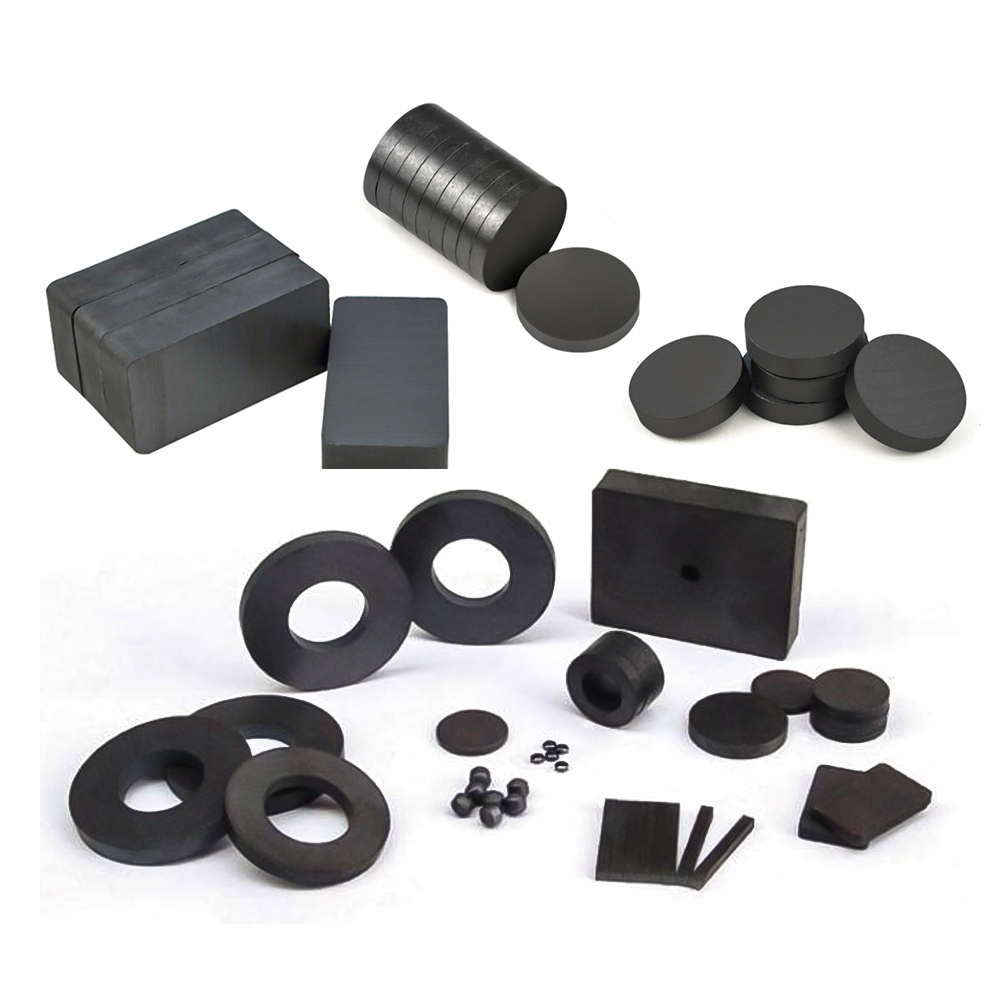
Manufacturers produce Ferrite Magnets primarily from iron oxide blended with either strontium or barium. The manufacturing process mirrors ceramics. Raw powders undergo pressing and high-temperature sintering. These components serve as the global industry standard for cost-effective, medium-strength magnetic needs. They typically offer a BHmax ranging from 1 to 5 MGOe. While they do not provide extreme strength, their reliability makes them ubiquitous in modern manufacturing.
Neodymium magnets belong to the rare-earth family. Their chemical composition combines Neodymium, Iron, and Boron (NdFeB). Engineers specify these materials when projects demand the absolute highest performance tier. Neodymium materials routinely achieve a BHmax between 35 and 52 MGOe. They dominate applications requiring extreme miniaturization. If your design needs immense pull force within a tiny physical footprint, NdFeB is the default choice.
A fundamental physical tradeoff governs magnetic design. You cannot swap materials one-to-one without altering the surrounding geometry. To match the magnetic pull force of a standard neodymium piece, a ceramic counterpart must be substantially larger. It will also be much heavier. You must accommodate this extra volume during the initial CAD phase. Relying on late-stage material swaps often leads to costly redesigns.
Common Mistake: Designers frequently assume they can switch from Neodymium to ceramic materials later to save money. If the product housing lacks the physical space for a larger magnet, this transition becomes impossible.
Raw strength tells only half the story. The operating environment dictates long-term viability. Exposing the wrong material to heat, moisture, or external fields leads to rapid failure.
Heat degrades magnetic performance. Every material features a specific threshold where it loses strength. Neodymium magnets typically operate safely up to 80°C. Specialized, more expensive grades can endure up to 200°C. Beyond these limits, NdFeB suffers irreversible demagnetization. Once cooled, it will not regain its original strength.
Conversely, ceramic options excel in high-heat environments. Standard Ferrite Magnets easily withstand operating temperatures up to 250°C. Some grades tolerate up to 300°C. If your application involves hot liquids, combustion engines, or industrial ovens, ceramic materials offer unmatched thermal stability.
Chemical stability varies wildly between the two materials. The iron content in Neodymium makes it highly vulnerable to oxidation. Without a protective barrier, NdFeB will rust, flake, and lose its magnetic charge in humid environments. Manufacturers must apply surface treatments. Common coatings include Ni-Cu-Ni (Nickel-Copper-Nickel), zinc, or epoxy. If this coating scratches, corrosion begins immediately.
Ceramic materials provide inherent chemical stability. Because they consist primarily of iron oxide, they are technically already oxidized. This chemical reality makes them virtually immune to standard corrosion. They require no protective plating. You can deploy them in wet, submerged, or highly humid applications without fear of rust.
Coercivity measures how well a material resists external demagnetizing forces. Neodymium boasts incredibly high intrinsic coercivity. It strongly resists demagnetization from opposing magnetic fields. Ceramic components have lower overall coercivity. However, their physical mass often compensates for this in practical applications. Both materials will maintain their magnetic fields for decades under normal conditions.
Performance Comparison Chart
Feature | Neodymium (NdFeB) | Ferrite (Ceramic) |
|---|---|---|
Max Pull Force / Density | Extremely High (35-52 MGOe) | Low to Medium (1-5 MGOe) |
Max Operating Temp | 80°C - 200°C (requires specific grades) | 250°C - 300°C |
Corrosion Resistance | Poor (Plating is mandatory) | Excellent (No plating required) |
Cost per Unit | High | Very Low |
Procurement teams must look beyond isolated technical specs. Material availability and production scaling heavily influence project viability over time.
Iron oxide and barium/strontium carbonate exist in massive global abundance. This stable supply chain keeps ceramic magnet pricing exceptionally predictable. Factories can source raw materials locally in almost every major manufacturing hub. In contrast, the rare-earth supply chain remains geographically constrained. Neodymium pricing experiences sharp fluctuations based on global trade policies, mining regulations, and export quotas.
Scaling up production reveals stark economic differences. The cost-per-unit drop-off heavily favors ceramic manufacturing. When producing millions of units, the material cost savings become massive. If your product geometry allows for a slightly larger component, Ferrite Magnets serve as the optimal choice. They protect profit margins on mass-market goods. Neodymium remains necessary only when space restrictions rigidly demand it.
Modern engineering requires a focus on sustainability. Commercial products face strict disposal and material recovery regulations. Ceramic materials pose very few environmental hazards upon disposal. They do not leach toxic heavy metals. Neodymium recovery is technically possible but economically challenging. The energy required to separate the rare-earth elements often exceeds the value of the recovered material. Designing with ceramic materials simplifies end-of-life environmental compliance.
Industry-specific demands clearly divide the use cases for these two materials. Let us explore where each type naturally excels.
The industrial sector utilizes both materials based on exact torque and sensor needs.
Neodymium: Engineers use NdFeB in electric vehicle (EV) drive motors. You will also find them in precision robotics, high-end automation sensors, and aerospace actuators. Their strength-to-weight ratio is crucial here.
Ferrite: These dominate standard automotive components. They power window wiper motors, cooling fans, and ABS sensors. They also serve extensively in industrial magnetic separators and heavy-duty loudspeakers.
Consumer markets show a similar divide based on premium versus utility applications.
Neodymium: Premium consumer electronics rely on rare-earth strength. They secure smartphone mounts, drive high-fidelity headphone speakers, and provide satisfying snap closures in luxury packaging.
Ferrite: Utility items prioritize cost. You will find them inside standard refrigerator magnets, whiteboard accessories, and large educational tools. They are the backbone of basic DIY and craft supplies.
Integrating permanent magnets into physical assemblies introduces mechanical challenges. You must handle both materials with care to prevent catastrophic failure.
Both material families are incredibly brittle. They behave more like glass or ceramic plates than tough metals. You should never utilize them as load-bearing structural components. Under excessive compression or bending forces, they will snap. Always design housings that isolate the magnet from direct mechanical stress.
Post-production modification is a severe engineering error. You cannot drill, tap, or saw a finished magnet. Attempting to machine a ceramic piece will shatter it. Machining a Neodymium piece is even more disastrous. Drilling breaches the anti-corrosion coating instantly. It also generates highly flammable rare-earth dust. Manufacturers must press or cast the raw material into its final geometric shape before the magnetization phase.
Safety risks scale alongside magnetic strength. Large Neodymium pieces pose severe danger. Two large NdFeB blocks can jump together from several feet away. The resulting impact can crush fingers, shatter the magnets, and send sharp shrapnel flying into the eyes. You require strict safety protocols, non-magnetic tools, and dedicated handling fixtures. In contrast, ceramic options present a much safer handling profile. Assembly line workers can handle them with basic standard operating procedures.
Use the following sequential framework to eliminate the wrong material quickly. This process saves engineering hours and prevents costly procurement mistakes.
Step 1: Assess Space and Weight Constraints. Measure the exact physical cavity available for the magnet. If extreme miniaturization is a rigid requirement, your decision is made. You must default to Neodymium.
Step 2: Define Environmental Extremes. Evaluate the product lifecycle. Will it operate outdoors, underwater, or in a highly humid environment? Will operating temperatures exceed 150°C? If you answered yes without a hermetically sealed enclosure, pivot immediately. Choose ceramic components or prepare to invest heavily in specialized, high-temp coated Neodymium grades.
Step 3: Analyze Budget vs. Volume. Review your target production volume. For mass-market products where profit margins are tight and physical space is somewhat flexible, mandate the use of ceramic options. The economic benefits at scale are impossible to ignore.
Next-Step Action: Prototyping is your best defense against failure. Do not rely entirely on spec sheets. Procure sample grades of both materials. Build a physical assembly. Test the pull force, heat tolerance, and assembly process in real-world conditions before committing to a high-volume manufacturing run.
There is no universal "better" magnet in modern manufacturing. Success relies entirely on finding the right engineering fit for your specific constraints. Over-specifying your design by purchasing rare-earth materials when standard ceramics would suffice drains your budget unnecessarily. Conversely, under-specifying your material choice degrades product performance and frustrates end users. Evaluate your physical space, respect your thermal limits, and calculate your volume economics. Contact a magnetic engineering specialist today. Request physical samples to test within your specific application environment to guarantee optimal performance.
A: No. The ferrite magnet will have a significantly weaker pull force. If you wish to switch materials, redesigning the housing to accommodate a much larger magnet is strictly required.
A: They lose magnetism extremely slowly. They maintain their magnetic field for decades. Permanent degradation usually only occurs if they are exposed to extreme external demagnetizing forces or temperatures beyond their rated limits.
A: The high iron content inside the alloy causes rapid rusting. When exposed to atmospheric moisture without a protective layer like Nickel or Zinc, the material oxidizes, flakes apart, and loses its magnetic strength.
A: Neither. Both materials are ceramic-like and highly brittle. Drilling or machining destroys their structural integrity. Magnets must be cast or pressed into their precise final shape before magnetization occurs.


