We are constantly trying to improve ourselves in new thoughts, new technology and new working methods.

Views: 0 Author: Site Editor Publish Time: 2026-08-27 Origin: Site


Procurement managers, mechanical engineers, and wholesale distributors face a constant balancing act. You must align necessary magnetic performance alongside strict unit-cost limitations. Striking this perfect balance keeps production running profitably. High-performance rare-earth magnets often cause severe budget overruns. They also introduce unwanted supply chain volatility into your daily operations. Fortunately, Ferrite Magnets deliver a highly stable, low-cost alternative. You just need to correctly map their operational constraints first. This guide bridges the gap between raw engineering specifications and commercial procurement realities. We offer a reliable framework to help you evaluate material grades and custom tolerances effectively. You will also learn exactly how to verify supplier reliability. Ultimately, this ensures you procure the right magnetic components without compromising your assembly line.
Cost-to-Performance Ratio: Ferrite is the optimal choice for high-volume applications where size and weight are less restricted but cost and corrosion resistance are critical.
Material Limitations: Due to their brittle ceramic nature, machining after pressing requires specialized diamond tooling, making upfront custom mold planning essential.
Supplier Validation: Reliable procurement requires vetting suppliers not just for unit price, but for batch-to-batch magnetic consistency, ISO certifications, and realistic lead times.
Manufacturers constantly battle volatile raw material costs. Rare-earth metals like neodymium experience frequent price spikes. These fluctuations complicate long-term budgeting. Conversely, iron oxide and strontium carbonate offer remarkable market stability. These base materials form the foundation of most commercial ceramic magnets. Because the raw ingredients are abundant, they shelter buyers from sudden global supply shocks.
You must identify the ideal use cases to maximize this cost advantage. Permanent Ceramic Magnets excel where volume and weight restrictions remain loose. DC motors utilize them extensively for dependable rotational torque. Acoustic speakers rely on their bulk mass to drive sound waves cleanly. Magnetic separators use large ceramic blocks to pull ferrous contaminants from industrial grain lines. Sensory relays also benefit from their predictable magnetic fields. In all these applications, physical space permits larger magnet designs. This allows engineers to achieve necessary flux densities without paying premium rare-earth prices.
Operating environments heavily influence magnet selection. Neodymium magnets corrode rapidly when exposed to moisture. They demand expensive nickel or epoxy coatings. Ceramic alternatives boast intrinsic corrosion resistance. Their oxide-based structure naturally repels oxidation. Therefore, they rarely require surface plating or protective coatings. This eliminates an entire secondary manufacturing step, directly reducing your unit cost.
Temperature stability represents another major advantage. Typical ceramic grades safely operate up to 250°C. They maintain structural integrity and magnetic force in demanding heat. In contrast, standard neodymium begins losing power around 80°C. Furthermore, ceramic materials strongly resist demagnetization from external fields. They provide a highly stable magnetic output over decades of use. You can confidently deploy them in rugged outdoor or high-heat industrial environments.
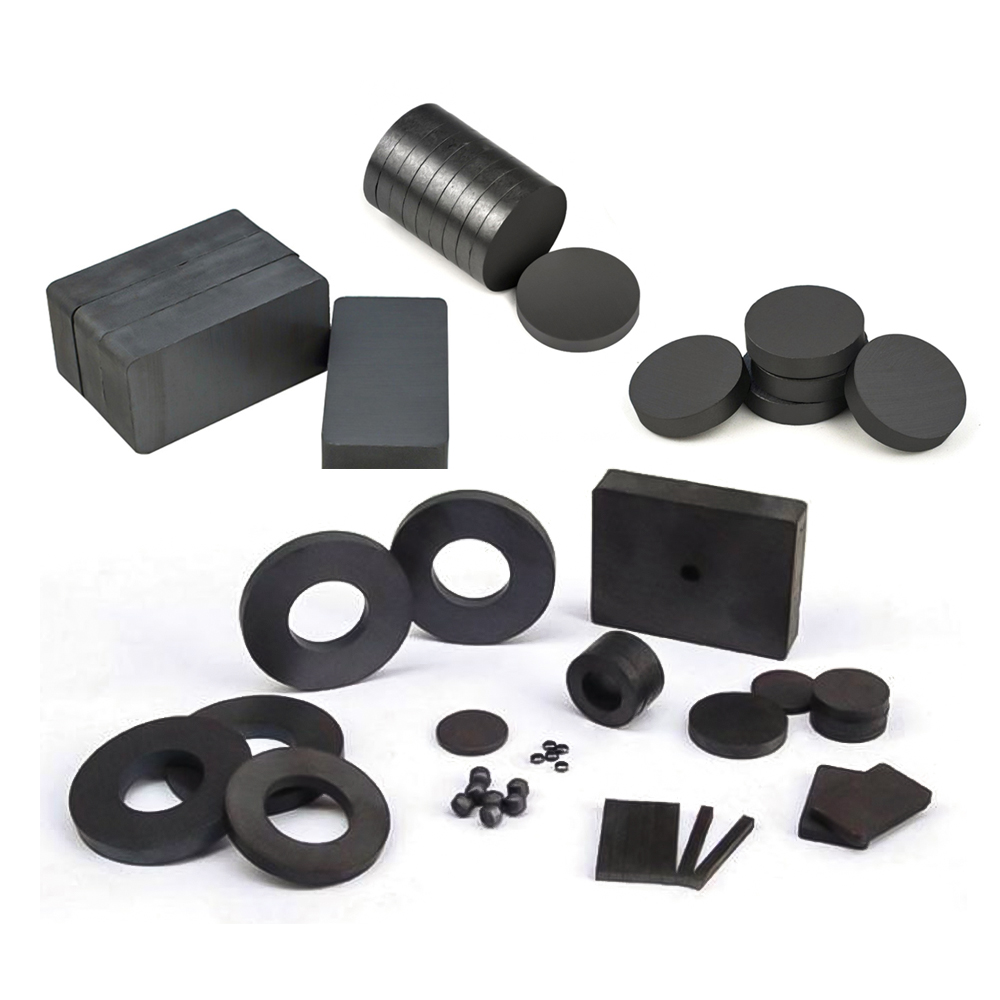
Manufacturing methods dictate ultimate magnetic performance. We classify these methods into two primary categories. The first is isotropic production. Here, factories press the raw powder without applying an external magnetic field. The internal particles remain entirely unaligned. This yields a lower overall magnetic energy. However, it offers significant magnetization flexibility. You can magnetize isotropic blocks in any direction post-production. They work beautifully for complex, multi-pole magnetization requirements.
The second category is anisotropic production. Factories apply a strong magnetic field during the pressing stage. This aligns the powder particles parallel to the magnetic field. Consequently, the final product yields significantly higher magnetic force. The trade-off is strict directional limitation. You are restricted to a single pre-determined magnetization axis. Anisotropic parts dominate high-performance motor applications where maximum directional strength is mandatory.
Regional naming conventions often confuse procurement teams. North American suppliers typically use the C-Series nomenclature. Global markets generally rely on the Y-Series designations. Understanding how these align helps you secure accurate quotes globally.
Consider a realistic comparison of commercial grades. Basic C1 equates roughly to Y10. These represent isotropic materials suitable for simple holding forces. Mid-range C5 compares to Y30. Engineers specify these for standard consumer electronics. High-end C8 aligns with Y35. These deliver maximum flux density for demanding applications.
Standard Grades Comparison Chart | |||
US Standard (C-Series) | Global Standard (Y-Series) | Magnetic Alignment | Common Application Outcomes |
|---|---|---|---|
C1 | Y10 | Isotropic | Basic holding applications, fridge magnets, simple sensors. |
C5 | Y30 | Anisotropic | Standard DC motors, standard acoustic speakers, magnetic couplings. |
C8 | Y35 | Anisotropic | High-torque motor arcs, heavy-duty separators, high-end audio. |
You must map specific grades to your desired outcomes. Select C8/Y35 for maximum flux density in motor arcs. Choose C1/Y10 when designing basic holding applications. We must be transparent about fundamental trade-offs here. Higher remanence (magnetic strength) often reduces coercive force (resistance to demagnetization). Finding the correct balance ensures your product functions reliably under load.
Understanding production mechanics prevents costly prototyping errors. Factories utilize two primary methods: dry pressing and wet pressing. Dry pressing works well for simple isotropic shapes. It requires less setup time and lower tooling costs. Wet pressing injects a slurry into the mold under a magnetic field. This process yields stronger anisotropic parts. However, wet pressing requires complex tooling and longer drying cycles.
Custom shapes inevitably drive up initial capital expenditures. Designing motor arcs or segmented rings requires upfront mold fees. Standard blocks and discs bypass these charges. Custom molds also enforce higher minimum order quantities (MOQs). Factories must justify the extensive machine setup time. You should budget for these custom mold fees early in your project planning phase.
Buyers must acknowledge the brittle reality of ceramic materials. These parts resemble standard dinnerware in terms of fragility. They are highly prone to chipping and cracking during handling. You cannot treat them like machined steel components.
Establishing realistic industrial tolerances saves money. Standard pressed dimensions typically hold a ± 2% tolerance. If your assembly requires tighter fits, factories must grind the surfaces. Ground surfaces routinely achieve ± 0.1mm tolerances. However, you must carefully avoid over-specifying tight tolerances. Aggressive tolerance demands dramatically drive up diamond-grinding costs. They also extend production lead times unnecessarily. Always design your mechanical assemblies to accept standard industrial variations.
Selecting a reliable supplier requires strict auditing procedures. Never judge a vendor solely on their quoted unit price. A qualified supplier must systematically prove their manufacturing consistency. You should demand hysteresis graph reports for every major batch. These graphs confirm the baseline magnetic properties match your specifications.
You must also analyze batch uniformity metrics. Request their CPK data (Process Capability Index). High CPK numbers indicate stable, repeatable manufacturing runs. You should clearly define acceptable flux density variance limits in your purchasing agreements. Furthermore, strict regulatory adherence is non-negotiable. Check for verifiable RoHS and REACH compliance. This is especially critical for European and North American distribution networks. Non-compliant shipments face immediate customs rejection.
Essential supplier verification checklist:
Review recent hysteresis graph reports for target grades.
Analyze internal CPK data for dimensional and magnetic consistency.
Verify active RoHS and REACH certifications.
Confirm ISO 9001 or IATF 16949 quality management credentials.
Procurement teams often overlook the hidden costs of shipping. Ceramic materials are dense and heavy. They also carry a very low cost per unit. This specific weight-to-value ratio means freight charges can disproportionately impact your overall budget. Air freighting these components is rarely economically viable.
You must implement smart logistics strategies. Container consolidation significantly reduces per-pallet ocean freight costs. You can also negotiate localized warehousing agreements. Many global suppliers will hold inventory in domestic warehouses for key clients. Alternatively, utilize blanket orders combined with staggered shipping releases. This secures bulk pricing while managing your immediate inventory space effectively. It keeps production lines fed without overwhelming your loading docks.
Transitioning from engineering drawings to active purchase orders requires a disciplined approach. Follow these sequential steps to protect your supply chain and your budget.
Step 1: Prototype Testing. Always demand off-the-shelf samples of equivalent grades first. Test these standard blocks in your application before commissioning expensive custom molds. This validates the magnetic circuit design practically.
Step 2: Coating/Finishing Verification. Assess your cleanliness requirements. The material boasts inherent corrosion resistance. However, raw parts leave microscopic ceramic dust. Confirm if your application strictly requires a dust-free surface. If so, specify a light epoxy coating or an ultrasonic cleaning process.
Step 3: Supplier Capability Mapping. Evaluate the vendor's physical equipment. Ensure they possess in-house magnetizing fixtures. They must prove capable of matching your specific multi-pole or radial alignment requirements accurately.
Step 4: Overall Cost Evaluation. Look far beyond the initial quote. Combine the basic unit cost with amortized custom tooling fees. Add your projected assembly scrap rates resulting from inherent material brittleness. Finally, include all landed freight costs. This provides the true financial picture.
Specifying these reliable components remains an exercise in strategic balance. You must weigh upfront tooling costs against substantial long-term operational savings. Rare-earth materials provide intense power but carry severe pricing risks. Ceramic alternatives deliver supreme market stability, excellent corrosion resistance, and dependable performance.
We advise buyers to approach potential suppliers fully prepared. Always provide complete 3D CAD files. Clearly state your required magnetic orientation vectors. Define your maximum target operating temperatures explicitly. This eliminates quotation guesswork and speeds up your procurement cycle. Encourage your engineers and buying teams to collaborate closely. Submit your comprehensive application specs for a commercial feasibility review and a formal tooling estimate today.
A: No, you cannot machine them with conventional steel tools. The material is a brittle ceramic. Post-delivery modifications require specialized diamond tooling and continuous water coolant. Attempting to drill or cut them normally causes immediate shattering.
A: This results from inherent material brittleness during bulk tumbling and transport. You must clearly define acceptable industrial standard chipping allowances in your purchase orders. Minor cosmetic edge chips rarely affect structural integrity or magnetic performance.
A: Ferrite suffers a temporary loss of coercivity at sub-zero temperatures. This significantly increases the risk of permanent demagnetization in freezing environments. Neodymium performs much better in extreme cold, whereas ceramic dominates in high-heat scenarios.


