We are constantly trying to improve ourselves in new thoughts, new technology and new working methods.

Views: 0 Author: Site Editor Publish Time: 2026-11-18 Origin: Site


Stray nails, jagged screws, and scattered metal fragments represent a silent but expensive threat to daily warehouse operations. Manual sweeping wastes valuable labor hours. Traditional floor scrubbers simply push sharp metal debris around, entirely missing the core hazard. Picture a bustling loading dock where a forklift rolls over a hidden self-tapping screw. The resulting flat tire instantly halts the supply chain. A specialized vehicle attachment provides the most practical remedy for this widespread industrial challenge. By deploying a robust Magnetic Sweeper, facility managers can instantly transform standard material handling vehicles into industrial-grade metal cleanup machines. This comprehensive guide details the essential technical specifications required to choose the exact equipment for unique operational environments.
Before diving into the technical specifications of warehouse maintenance equipment, logistics coordinators must understand the core factors determining the effectiveness of a metal collection system. Evaluating these parameters ensures data-driven purchasing decisions.
Protect Your Fleet: Deploying a heavy-duty attachment drastically reduces tire repair costs. It prevents workflow interruptions and extends the lifespan of expensive tires by removing puncture hazards from operational zones.
Size Matters: Selecting the correct sweeping dimension is critical. It ensures maximum floor coverage per pass without compromising vehicle maneuverability in tight storage aisles.
Mounting is Crucial: A secure hanging mechanism or integrated fork-pocket design guarantees safe and stable operation. This prevents equipment detachment even when navigating uneven terrain.
Efficiency is Key: Opting for a model equipped with a quick-release mechanism saves valuable labor time. It strictly mitigates safety risks during the debris disposal process.
Performance Metrics: The ultimate empirical test of this equipment is its magnetic pull capacity. Engineers must evaluate this at various operating speeds and ground clearances.
Stray metal on industrial floors is more than a mere nuisance. It drains maintenance budgets rapidly. A single industrial pneumatic tire costs hundreds of dollars to replace. The specialized labor required for installation adds heavily to the overall expense. When a vehicle runs over an industrial staple, the structural integrity of the tire is compromised. Maintaining safety standards often requires immediate replacement.
Indirect expenses are often more damaging to a company bottom line than direct replacement costs. A sidelined forklift results in delayed shipments, idle operators, and disrupted supply chains. Sharp metal shrapnel also poses a severe safety liability. If a tire blows out under a heavy load, it can cause the vehicle to tip. This immediately endangers the operator and nearby personnel.
Calculating the return on investment for this attachment yields straightforward and highly favorable math. A high-quality industrial magnet typically costs a fraction of annual tire replacement budgets. By preventing just two or three tire punctures, the equipment effectively pays for itself within the first few months of deployment.
Recent supply chain analyses reveal a definitive shift in warehouse maintenance strategies. Driven by the relentless pace of global e-commerce, logistics managers are abandoning reactive tire repairs. Instead, they embrace predictive fleet protection. The prevailing industry trend heavily favors automated passive floor cleaning methods over manual labor. Integrating magnetic attachments into daily workflows allows high-volume distribution centers to report measurable reductions in operational downtime. This shift underscores a broader industry realization. Preventing a hazard is exponentially cheaper than mitigating its aftermath. Comparing this automated approach to manual push-type sweepers highlights further cost savings. Continuous floor cleaning is achieved without incurring additional labor costs.
These devices operate using permanent magnetic fields. They require no external power source, hydraulic lines, or electrical integration with the vehicle. The internal assembly typically consists of high-grade ceramic or neodymium magnets. Engineers strategically arrange these permanent magnets to project a deep and consistent magnetic field downward toward the floor.
The magnets are housed inside a heavy-duty casing. Manufacturers usually construct this from non-magnetic 304 stainless steel or heavy-gauge extruded aluminum. This non-ferrous housing allows the magnetic field to penetrate through to the ground. Simultaneously, it provides a durable shield against blunt impacts, moisture, and corrosive industrial chemicals.
Industrial vehicles utilize two primary configurations for attaching these devices. Each serves different operational workflows.
Fork-Mounted Models: These units feature built-in rectangular pockets. The operator simply drives the tines directly into the pockets and secures them. This design is highly favored for quick temporary deployment. When a spill occurs in a specific aisle, a fork-mounted unit can be attached in seconds. The operator deploys it to clean the area and removes it just as quickly.
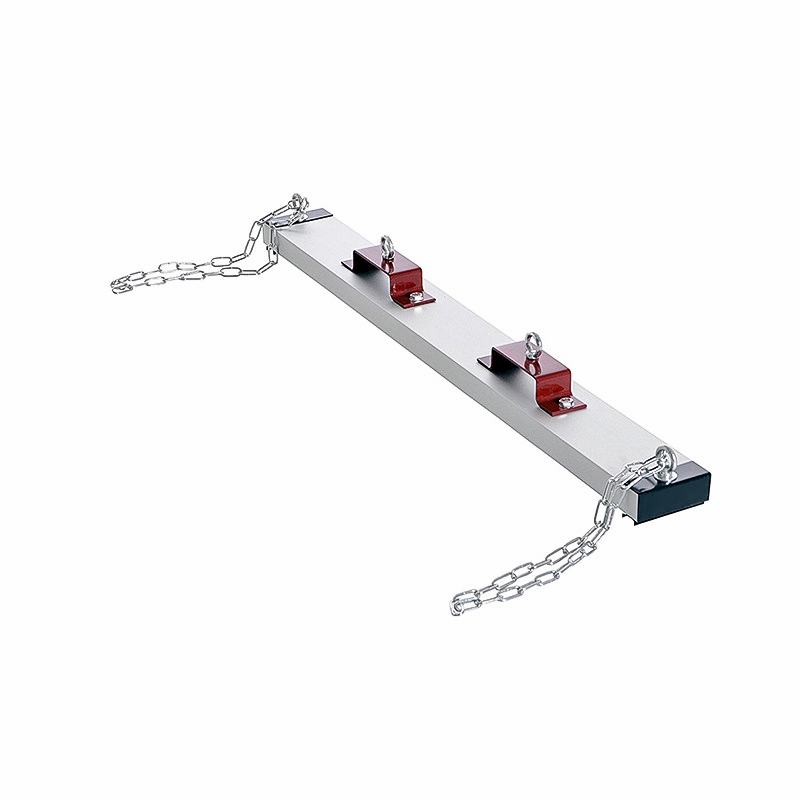
Suspended Models: Suspended units are designed for continuous passive operation. They hang from the front or rear bumper using heavy-duty chains and brackets. Because they do not occupy the forks, the vehicle can continue its primary lifting and material handling duties while simultaneously sweeping the floor.
The physical dimensions of the attachment directly dictate its efficiency and safety within a specific environment. Standard industrial models are typically manufactured in increments of twelve inches. The most common sizes are 48-inch, 60-inch, 72-inch, and 84-inch models. Custom 96-inch units are also available for specialized large-scale applications.
Selecting the correct Sweeping Width involves calculating the total square footage of the facility and dividing it by the average operating speed of the vehicle. A wider unit covers more ground per hour. This reduces the number of passes required to clean a large area. Wider is not always better if the facility layout does not accommodate the size.
Fleet managers must balance the desire for maximum floor coverage with the practical limitations of maneuverability. Wider sweepers measuring 72 inches and above are highly recommended for wide aisles, open outdoor yards, and large shipping docks. These open environments allow operators to drive in long straight lines without navigating tight corners.
A narrower width spanning 48 to 60 inches is absolutely essential for facilities with narrow aisles, dense racking systems, or cluttered production floors. If an attachment extends too far past the wheelbase, it creates a severe collision hazard. Operators turning corners could easily strike structural columns or inventory with the protruding ends. This causes costly structural damage.
The most prevalent attachment method in the industry utilizes slip-on fork pockets. These are heavy-duty rectangular steel tubes welded directly to the top of the housing. To install the unit, the operator aligns the tines with the pockets and drives forward until the unit rests against the heel of the forks. Drivers must ensure the tines are free of heavy grease to prevent slippage before the fasteners are engaged.
Securing the unit is non-negotiable. High-quality models utilize heavy-duty T-bolts, locking pins, or cam-lock mechanisms. These tighten against the steel to prevent sliding during sudden stops. Facility managers must empirically measure their tines before purchasing to ensure compatibility with the manufacturer pocket dimensions.
Facilities opting for bumper-mounted configurations must utilize a specialized Forklift Hanger system. This setup typically involves bolting heavy-duty steel brackets directly to the vehicle frame. The magnet is then suspended using industrial-grade chains.
The primary mechanical advantage of a chain-based suspension is flexibility. A rigidly mounted magnet might strike the ground violently when operating on uneven terrain, loading ramps, or transition plates. A chain suspension allows the equipment to swing slightly upon impact. This action absorbs the kinetic energy and protects the internal ceramic blocks from shattering.
Standard low-cost magnets often lack a release mechanism. The collected metal remains strongly adhered to the bottom of the housing. Requiring operators to manually wipe sharp metal shavings, rusted nails, and jagged welding slag off a raw magnet is a severe safety hazard. The risk of lacerations and subsequent infections remains unacceptably high even with heavy-duty leather gloves.
Premium models are engineered with an integrated Release Handle to mitigate these severe risks. This mechanical feature transforms a hazardous chore into a safe five-second operation. The permanent magnets are mounted on a movable tray within the outer stainless steel housing. A mechanical linkage lifts the internal tray upward when the operator pulls the lever. The magnetic field at the surface drops to zero as the distance between the magnets and the collected debris increases. The scrap then falls safely into a designated bin.
The industry offers different tiers of release mechanisms based on budget and efficiency requirements. Standard manual systems feature a robust pull-lever located on the top of the sweeper. The operator must park the vehicle, step down, position a collection tray, and pull the lever. Advanced automatic or remote-release systems utilize extended cables or pneumatic cylinders connected to existing hydraulic lines. These allow the driver to position the unit over a disposal bin and release the debris without ever leaving the seat.
The ultimate empirical test of this equipment is its Nail Pickup efficiency. A unit that leaves behind twenty percent of the debris is a liability rather than a solution. The effectiveness of collection is dictated by the inverse-square law of magnetic fields. The strength of the pull decreases exponentially as the distance from the magnet increases.
The unit can be lowered to within 1.5 to 2 inches of the ground for smooth indoor concrete floors. Even a moderately strong magnet will achieve a near perfect collection rate at this height. The clearance must be raised to 4 to 5 inches for outdoor gravel yards or uneven asphalt to prevent dragging. Maintaining high collection rates at this elevated height requires a heavy-duty unit packed with high-density neodymium magnets.
Magnetic fields require a fraction of a second to overcome the inertia and gravity of a metal object resting on the floor. This physics concept dictates the maximum speed at which the vehicle can operate while sweeping. The magnet passes over a fastener too quickly for the field to lift it if an operator drives at ten miles per hour. Operators should maintain a consistent sweeping speed of 3 to 5 miles per hour for maximum efficiency and safety.
A properly calibrated system captures a vast array of ferrous materials. Common industrial debris successfully managed includes roofing nails from pallet repair zones, jagged metal shavings from CNC machining areas, broken steel banding clips from shipping docks, and welding slag from fabrication shops. These systems only attract ferrous metals containing iron and carbon steel.
Installing a magnetic attachment requires precision and strict adherence to standard material handling safety protocols. Park the vehicle on a level concrete surface for slip-on pocket models. Adjust the width of the tines to exactly match the distance between the built-in pockets. Slowly drive forward. Slide the tines completely in until the back of the housing rests flush against the carriage. Engage the locking mechanisms securely.
Personnel must be highly aware of pinch points during installation. The magnetic field of a heavy-duty unit is exceptionally strong. Keep all steel tools, jewelry, and loose metal objects away from the bottom of the housing. This prevents sudden magnetic snapping which can cause severe crush injuries.
A common misconception assumes the sweeping equipment requires zero maintenance because permanent magnets do not lose their charge over time. The internal field remains stable, but the external housing and mechanical levers are subjected to harsh industrial environments.
Utilize the release mechanism after every shift to drop all collected metal into a designated bin. This ensures consistent performance. Never leave metal debris attached overnight. Sharp objects can scratch the housing and moisture can induce localized oxidation. Regularly inspect the T-bolts, locking pins, or chain links. Vibrations from solid pneumatic tires on rough concrete can slowly loosen mechanical fasteners.
Making a data-driven procurement decision requires comparing the core features of different sweeper styles against your specific facility needs. Use the following technical matrix to guide your selection process.
Feature Matrix | Fork-Mounted Models | Hang-Type Suspended Models |
|---|---|---|
Primary Use Case | Quick spill response, temporary deployment | Continuous passive sweeping, rough terrain |
Installation Time | Under 60 seconds | Initial bracket bolt-on takes 15 minutes |
Impact Resistance | Rigid mount transfers shock to housing | Chains absorb kinetic energy naturally |
Fork Availability | Occupies forks during sweeping | Forks remain completely free for lifting |
The physical characteristics of the facility terrain directly dictate the required pull strength and the necessary ground clearance. A sweeper can be operated with minimal ground clearance in indoor distribution centers with polished concrete. Outdoor lumber yards and construction sites feature uneven terrain and loose gravel. These require elevated clearances and substantially stronger magnetic arrays.
Prioritize Total Cost of Ownership over the initial purchase price when evaluating procurement options. The industrial environment is unforgiving. Avoid models constructed with thin PVC plastics or low-gauge sheet metal. They are highly susceptible to cracking and bending. Allocate budget toward units constructed from heavy-gauge extruded aluminum or 304 stainless steel. These materials provide exceptional structural integrity while remaining non-magnetic themselves.
Ensure seamless compatibility between the attachment and your existing fleet. Verify the exact weight of the unit and cross-reference it with the vehicle load chart. Measure the exact width, thickness, and maximum spread of your tines to guarantee they fit comfortably inside the pockets. Calibrate the sweeping width against the narrowest aisles in your facility to prevent structural collisions.
A forklift-mounted magnetic sweeper adds immense value to industrial fleets. It reduces tire damage and prevents costly operational downtime effectively. Always evaluate the physical width and hanging systems carefully to ensure they match daily workflows. Ensure high collection rates and strictly require a mechanical release mechanism to protect workers from handling sharp scrap. Assess your warehouse layout, measure your equipment, and explore the robust lineup at Shine Magnetics to find the perfect sweeping solution for your facility today.
Yes, but specific equipment modifications are required. You must utilize a heavy-duty model engineered with a substantially stronger magnetic pull. This increased strength allows the operator to raise the ground clearance to four to six inches. It prevents the housing from dragging on rocks, uneven dirt, or potholes, while still maintaining an excellent collection rate from within the crevices of the rough terrain.
Operators should maintain a driving speed between three to five miles per hour for optimal debris collection. Driving at higher speeds introduces excessive kinetic energy. The magnet may not have sufficient time to attract heavy metal objects. The physical impact of hitting larger debris at high speeds could also knock already-collected metal off the housing and back onto the floor.
High-quality permanent magnets such as neodymium or industrial ceramic block magnets are highly stable. They will retain their magnetism indefinitely under standard warehouse conditions. They typically only suffer magnetic degradation if exposed to extreme unnatural heat or if subjected to severe repeated blunt-force trauma that physically shatters the internal magnetic lattice.
The mechanism operates on a simple but highly effective mechanical principle. The permanent magnets are housed inside a non-magnetic shell. An internal mechanical linkage physically lifts the heavy magnet assembly upward and away from the bottom of the outer shell when the operator pulls the lever. The magnetic field holding the metal to the shell dissipates as the distance between the magnet and the collected debris increases. This causes the collected scrap to instantly drop into a disposal bin.
No. These devices operate strictly on the principles of ferromagnetism. They will only attract and collect ferrous metals containing significant amounts of iron. Non-ferrous metals including aluminum, brass, copper, titanium, and certain grades of austenitic stainless steel do not interact with magnetic fields and will remain on the ground.
Yes, provided the unit features a fully sealed housing. Industrial sweepers encased in heavy-gauge aluminum or 304 stainless steel are highly resistant to moisture and rust. Water does not block magnetic fields. You can sweep wet asphalt or rainy loading docks with the same efficiency as dry concrete. Operators must simply ensure they wipe down the external housing after use to prevent localized oxidation on the mechanical release joints.
You must measure three critical dimensions on your vehicle tines. Measure the maximum width of a single tine, the maximum thickness near the heel, and the maximum spread distance from the outside edge of the left tine to the outside edge of the right tine. Compare these three empirical measurements against the internal pocket dimensions and pocket spacing provided by the sweeper manufacturer to guarantee a secure slip-on fit.


