We are constantly trying to improve ourselves in new thoughts, new technology and new working methods.

Views: 0 Author: Site Editor Publish Time: 2026-11-13 Origin: Site


Imagine carefully tramming a delicate aerospace component on your machine table. Suddenly, a micro-second power flicker compromises the entire setup. Is poor work securing ruining your machining precision? Choosing the right tools is always critical. Yet, many machinists struggle to select the correct clamping method. Traditional mechanical vises certainly have their place. However, modern manufacturing often demands unobstructed access and zero-distortion clamping.
This is where specialized magnetic solutions come into play. Permanent options offer unique, energy-independent benefits. They also possess strict operational limits. In this comprehensive guide, you will learn exactly when and how to utilize a permanent magnetic fixture. We will explore internal mechanics, ideal applications, and critical buying considerations. Armed with this knowledge, you can make an informed addition to your shop floor.
No Power Required: Operating entirely independently of electrical grids, these devices are inherently safe. They are naturally immune to facility power outages.
Ideal for Precision Abrasive Machining: They remain the industry-standard solution for high-precision surface grinding, electrical discharge machining, and light tool-room milling.
Low Thermal Distortion: They lack electrical coils and generate zero heat. This ensures strict dimensional accuracy without the risk of thermal expansion.
Managing Magnetization: Understanding how to properly demagnetize workpieces is a crucial operational requirement when implementing this technology.
Cost-Effective and Low Maintenance: Featuring no internal electrical components or complex wiring harnesses, they offer an extended operational lifespan with minimal necessary upkeep.
Recent industry analyses highlight a massive shift toward sustainable, energy-independent manufacturing. Machine shops face rising facility energy costs and strict carbon footprint mandates. Consequently, equipment that operates without a continuous electrical draw is dominating the market. Furthermore, modern aerospace and medical sectors demand extreme thermal stability. Eliminating heat-generating electrical coils from the worktable is no longer just a preference. It has become a strict quality control requirement. This trend heavily favors permanent magnetic clamping technologies for precision finishing, where even minor thermal expansion leads to scrapped parts.
A permanent Magnetic Chuck serves as a highly specialized anchoring device in metalworking and manufacturing environments. Its fundamental job is to securely hold ferromagnetic materials like iron, carbon steel, and cobalt alloys during various machining processes. Traditional vises apply physical pinching pressure to the sides of a part. In contrast, this tool utilizes invisible magnetic flux to pull the workpiece absolutely flat against its precision-ground surface.
The core component is the integrated magnetic material housed directly within the base. Manufacturers typically utilize high-strength rare-earth elements such as Neodymium or durable Alnico alloys. These advanced materials generate a constant, powerful, and stable field. They require absolutely no external electrical power source or bulky control unit.
By replacing traditional mechanical clamping, machinists gain unobstructed, five-sided access to the workpiece. Operators can continuously machine the top and side profiles. You never have to stop the spindle to unclamp, reposition, and reclamp the part. This seamless workflow leads to a massive reduction in setup times and a measurable increase in overall manufacturing throughput.
To truly appreciate the reliability of this equipment, look at its internal sliding mechanism. The unit features two primary assemblies. First is a stationary bottom plate packed with magnets. Second is a movable top grid, often called the pole plate. This top plate consists of alternating steel pole pieces and non-magnetic separators made from brass, epoxy, or stainless steel. The internal magnetic grid physically slides back and forth beneath this top plate.
Operation relies entirely on the manual alignment and misalignment of flux lines.
Rotate the actuation lever to the ON position. You will feel a distinct mechanical clunk. This internal shift aligns the permanent magnets directly with the ferromagnetic steel pole pieces on the top plate. The flux lines are forced to travel upward. They exit the surface, pass through your steel workpiece, and return to the adjacent pole piece. This continuous loop effectively locks the metal tightly against the table. High-end industrial models routinely deliver holding forces up to 160 N/cm² using this exact principle.
Conversely, rotating the lever back to the OFF position shifts the internal grid once more. The magnets now align with the non-magnetic separators. The flux lines are safely short-circuited within the steel body of the unit itself. The surface field drops to near zero. You can then easily slide the finished component off the table.
This physical lever actuation defines the system. Engagement relies entirely on mechanical movement rather than electrical relays. Therefore, it is exceptionally reliable. You never have to worry about blown fuses, severed cables, or complex control panel malfunctions. A simple, firm rotation of a handle achieves maximum downward holding force.
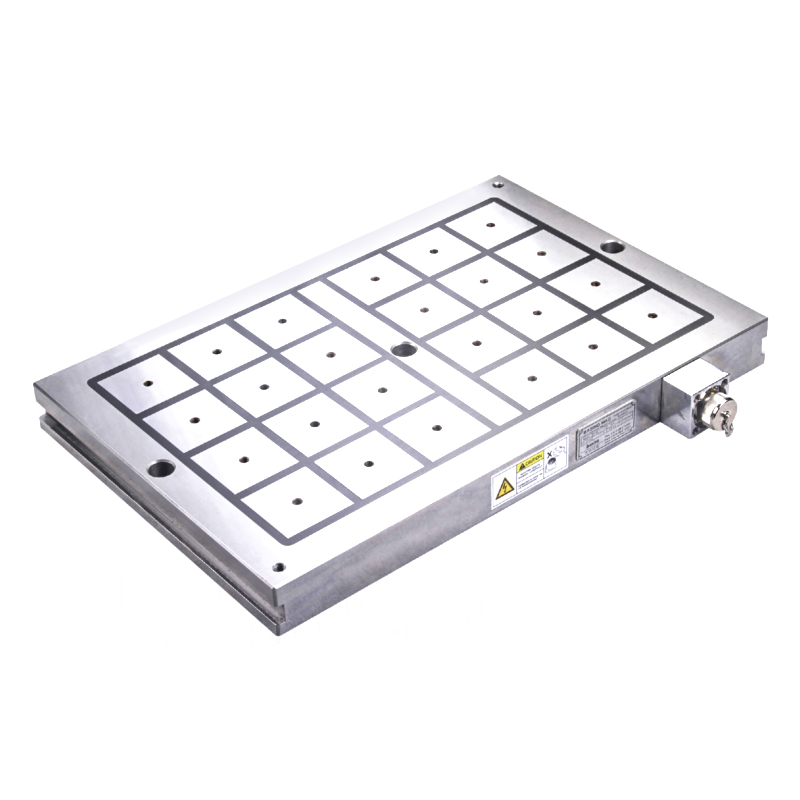
Choosing the correct securing method depends heavily on balancing efficiency trends with your specific machining operations. These fixtures excel in very specific shop floor scenarios.
This tool is universally recognized as the gold standard for surface Grinding. Abrasive operations aim to achieve extreme flatness, tight dimensional tolerances, and mirror-like surface finishes. Mechanical clamps inevitably introduce localized stress. They cause thin or delicate plates to bow slightly. When you release those clamps, the material springs back. This instantly ruins your hard-won flatness. A magnetic base applies uniform, downward pressure across the entire contact area. It completely eliminates mechanical distortion. Furthermore, their waterproof nature makes them perfectly suited for the heavy flood coolant environments typical of wet grinders.
These devices are not suited for aggressive hogging. However, they are highly effective for light to medium milling tasks. You can successfully execute face milling, precise profile cutting, and drilling. The key is ensuring cutting forces do not exceed the lateral friction limit. Experienced machinists frequently use solid side stops or blocking blocks alongside the magnet. This prevents the workpiece from sliding under the lateral shear forces generated by a carbide endmill. This specific setup allows for lightning-fast part changeovers during medium-volume production runs.
In die-sinking and wire EDM applications, the block must often be fully submerged in a dielectric fluid. Deploying electrically powered clamping devices in these submerged environments requires complex waterproofing. It also carries inherent hazard risks. Permanent systems contain absolutely zero wiring or live circuits. They can sit safely submerged in dielectric fluids indefinitely. They provide a rock-solid, interference-free hold that will never disrupt the delicate spark erosion process.
Implementing this technology into a daily workflow offers distinct, measurable advantages over both traditional mechanical vises and electromagnetic alternatives.
In industrial environments, operator safety dictates every setup. The most significant benefit of a Permanent Magnet is its fail-safe nature. Physical rare-earth materials generate the field. The grip is entirely independent of your building power grid. If a severe storm knocks out shop power, an electromagnetic system will instantly drop the part. This can cause catastrophic damage to the spindle or the operator. In stark contrast, a permanent setup maintains its full holding force indefinitely. The heavy block remains safely anchored until manually released.
Precision machining frequently deals with tolerances measured in the tenths of a thousandth of an inch. Electromagnetic units utilize internal copper coils. These coils naturally generate heat as electrical current passes through them. This thermal energy transfers directly into the workpiece, causing the metal to subtly expand during cutting. Once the part cools and contracts on the inspection bench, dimensional inaccuracies appear. Permanent models operate strictly at ambient room temperature. They generate zero heat, completely eliminating thermal distortion.
These units are entirely self-contained. They require no external control boxes, direct current power supplies, or delicate wiring harnesses. Installation is incredibly straightforward. Simply bolt or toe-clamp the base to the T-slots of your machine table. This lack of tethering allows for exceptional portability. A quality inspector can easily unbolt the chuck, lift it with a gantry crane, and transport it directly to a coordinate measuring machine. Critical datum references remain perfectly intact because you never release the workpiece.
Despite their numerous advantages, these tools are not a universal fix-all. Understanding physical limitations is critical to preventing scrapped parts and maintaining a safe working environment.
The primary limitation is the maximum holding threshold. This is fixed and cannot be artificially increased. During heavy-duty roughing or aggressive face milling, cutting tools exert massive lateral shear and lifting forces. If these violent forces exceed the frictional resistance provided by the downward magnetic pull, the workpiece will slide. It could be dangerously ejected from the enclosure. For aggressive material removal rates, heavy-duty mechanical vises or specialized hydraulic clamps are mandatory.
Dictated by fundamental physics, magnetic Work Holding is strictly limited to ferromagnetic materials. It performs brilliantly on carbon steels, cast iron, and martensitic stainless steels. However, it is entirely useless for securing non-magnetic stock. Aluminum, brass, copper, titanium, plastics, and austenitic stainless steels like 304 or 316 simply will not hold. Machining these materials requires vacuum tables, mechanical fixtures, or modern adhesive solutions.
Holding force relies heavily on the intimate contact between the top plate and the workpiece bottom. Magnetic flux degrades exponentially the moment it encounters an air gap. A raw casting with a rough, heavily scaled, or severely warped bottom surface will not sit flush. These microscopic air gaps severely interrupt the magnetic circuit. This drastically reduces the effective grip. These devices perform best on stock that already possesses a relatively flat and smooth locating surface.
To make an informed purchasing decision, compare the permanent variant directly against the electromagnetic system. Here is a breakdown of the critical differences.
Feature | Permanent Magnetic Chuck | Electromagnetic Chuck |
|---|---|---|
Power Source | Manual lever actuation. Zero electricity required. | Requires continuous DC electrical power. |
Safety in Power Outage | Fail-safe. Maintains full grip indefinitely. | Drops part immediately upon power loss. |
Thermal Distortion | Zero heat generated. Perfect for high precision. | Coils generate heat, causing slight part expansion. |
Holding Force Control | Binary. It is either fully ON or fully OFF. | Variable. Can adjust pull to shim warped stock. |
Automation Compatibility | Poor. Requires a human operator to pull the lever. | Excellent. Integrates seamlessly with CNC M-codes. |
A common phenomenon associated with this clamping style is Residual Magnetism. When a block of steel is exposed to an intense localized field, its internal magnetic domains align. After you turn off the lever and remove the part, a portion of these domains remain stubbornly aligned. The finished piece retains a slight, lingering charge.
This retained charge causes highly frustrating issues in downstream processes. The magnetized part acts like a sponge for metallic dust. It attracts grinding swarf and tiny chips. This contamination causes premature wear on mating components during final assembly. It severely interferes with sensitive measuring instruments like dial indicators. It can also disrupt subsequent TIG welding operations by causing erratic arc blow.
The standard industrial solution is remarkably simple. Use a demagnetizer. Available in surface plate or pass-through tunnel configurations, these devices subject the workpiece to a rapidly alternating, gradually decaying AC magnetic field. Passing the part smoothly across the demagnetizer scrambles the aligned domains within the steel. This effectively returns the component to a completely neutral state.
Selecting the correct unit requires a careful evaluation of your specific daily machining parameters. Do not buy blindly based on price. Match these technical specifications to your typical stock.
The pole pitch refers to the measured distance between the steel pole pieces and the non-magnetic separators on the top surface. This dictates how deep the magnetic field penetrates your part.
Choose a Fine Pole Pitch like 1.5mm to 2mm if: Your typical workpieces are thin plates under 5mm thick, or very small components. Narrow poles pack tightly together. The resulting flux lines are shallow but incredibly concentrated at the surface. This prevents the field from passing completely through a thin part and wasting holding energy in the air above.
Choose a Standard or Coarse Pole Pitch like 5mm to 8mm if: You are machining thick, large, and heavy blocks. Wider steel poles force the flux lines to travel much deeper into the material before looping back. This deep penetration provides maximum holding security for heavy stock.
Always review the manufacturer technical data sheet for the rated holding force. It is typically measured in Newtons per square centimeter. A high-quality industrial unit designed for grinding should confidently offer a holding force between 100 and 160 N/cm². Ensure this metric comfortably exceeds the lateral cutting forces generated by your heaviest intended machining operations.
The precision of the internal construction matters. The grade of the rare-earth elements and the integrity of the top plate epoxy sealing dictate equipment longevity. Purchasing from a reputable manufacturer ensures the internal sliding mechanisms will not bind up over time. The unit will remain perfectly waterproof after years of exposure to harsh synthetic coolants.
A permanent magnetic chuck represents a highly reliable, inherently safe, and completely heat-free clamping solution for the modern machine shop. It is the perfect companion for precision surface grinding, intricate EDM work, and light tool-room milling. It cannot entirely replace heavy-duty mechanical vises for high-horsepower hogging operations. However, it remains an absolutely indispensable tool for distortion-free finishing and rapid part changeovers. Take the time to evaluate your specific daily machining needs, workpiece sizes, and workflow bottlenecks. Choosing the right magnetic holding tool will drastically reduce setup times and boost your workshop efficiency. Ready to upgrade your work holding strategy? Visit Shine Magnetics to explore high-quality, precision-engineered magnetic chucks and elevate your manufacturing capabilities today.
Because they utilize high-grade permanent magnets like Neodymium and contain absolutely no electrical components to burn out or degrade, they can easily last for many decades. Under normal operating conditions, they only lose a tiny, practically unnoticeable fraction of their magnetism over a 10-to-20-year lifespan.
Yes, absolutely. These units are completely sealed and waterproof by design. This makes them perfectly safe to use with heavy flood liquid coolants during wet grinding and milling operations. There is zero risk of internal corrosion or electrical shorting.
High-quality industrial magnetic chucks typically generate a holding force ranging from 100 N/cm² to 160 N/cm². The exact force depends heavily on the internal magnet grade, the pole pitch design, and the surface contact quality of the workpiece being held.
Permanent magnetic chucks rarely lose their magnetism under normal shop conditions. However, exposing the chuck to extreme temperatures exceeding the magnet's Curie point, or subjecting it to severe physical impacts, can permanently damage the internal magnetic domains and reduce holding power.
This entirely depends on the specific metallurgical grade of the steel. Martensitic and ferritic stainless steels are highly ferromagnetic and will hold very well. However, austenitic stainless steels like the common 304 or 316 grades are generally non-magnetic. They cannot be secured safely by magnetic flux.
The localized field primarily magnetizes the steel workpiece sitting on top of it, not the cutting tools in the spindle. However, if a high-speed steel or carbide tool comes into direct, prolonged contact with the magnetized workpiece, it may pick up a slight residual charge. Running the tool over a standard demagnetizer easily and instantly resolves this minor issue.


