We are constantly trying to improve ourselves in new thoughts, new technology and new working methods.

Views: 0 Author: Site Editor Publish Time: 2026-05-04 Origin: Site


Framing the material selection between a ferrite magnet and a neodymium solution is a critical engineering bottleneck. Selecting the wrong magnetic material directly impacts your product's lifecycle expenses. It also bloats the physical footprint and increases field failure rates. You cannot afford to guess during the design phase.
Neodymium serves as the industry default for raw power. However, ferrite frequently provides superior stability in extreme environments. It delivers this reliability at a fraction of the cost. Engineers must weigh these variables carefully to protect profit margins.
This guide skips the basic science. Instead, we focus on commercial evaluation, supply chain scalability, and implementation risks. We aim to help engineering and purchasing teams finalize their Bill of Materials (BOM). You will learn exactly how to balance performance demands against budget constraints.
Strength vs. Size: Neodymium delivers up to 1.4 Tesla (2-7x stronger than ferrite), making it mandatory for constrained spaces, while ferrite requires a larger footprint for equivalent power.
Environmental Resilience: Ferrite Ceramic Magnets are naturally corrosion-resistant and actually gain coercivity (resistance to demagnetization) as temperatures rise, whereas standard neodymium degrades rapidly above 80°C and rusts without protective plating (Ni-Cu-Ni).
Cost & Volatility: Ferrite costs roughly 80% less per kilogram with highly stable pricing; neodymium pricing fluctuates heavily due to rare-earth supply chain dynamics.
System-Level Efficiency: The choice hinges on duty cycles—neodymium lowers lifecycle energy costs in continuous-use motors, while ferrite is economically superior for occasional-use applications.
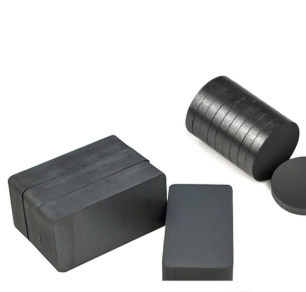
You must evaluate magnetic yield against available space. Neodymium yields roughly 1.4 Tesla. In contrast, ferrite produces between 0.2 and 0.5 Tesla. This means neodymium is two to seven times stronger for the exact same volume.
This strength gap introduces the "Miniaturization Paradox." High magnetic strength allows engineers to shrink surrounding motor components. You can use less copper in your coils. You can design a smaller, lighter housing. In compact devices like automotive audio systems or electric vehicle (EV) motors, these spatial savings easily offset the higher magnet cost. If your product requires a tiny form factor, neodymium is usually the only viable engineering choice. If space is not a constraint, a ferrite magnet offers ample power at a lower price.
Temperature dictates magnetic performance. You must match the material to the operating environment.
High-Temperature Realities: Standard neodymium loses its magnetic force quickly once temperatures exceed 80°C. If you need neodymium in hot environments, you must purchase expensive high-temperature AH grades. Conversely, ferrite functions safely up to 250°C to 300°C. Even more impressively, its coercivity actually increases as it gets hotter. It gains roughly 0.27% in demagnetization resistance per degree Celsius of heat.
Cold Weather Degradation: Ferrite struggles in sub-zero environments. It loses effectiveness below 0°C. If you design winter equipment or commercial refrigeration units, ferrite can fail you. Neodymium maintains its structural and magnetic integrity much better in extreme cold, making it the safer specification for freezing temperatures.
Best Practice: Always verify your product's peak operating temperature and its lowest ambient storage temperature before selecting a material.
You must assess environmental vulnerabilities early in the design cycle. Neodymium contains a massive amount of iron. This guarantees rapid oxidation. If you deploy neodymium without an intact surface plating—usually a nickel-copper-nickel (Ni-Cu-Ni) coating—it will rust and disintegrate.
In contrast, Ferrite Ceramic Magnets are already oxidized. They consist of ferromagnetic metal oxides. This chemical structure renders them permanently rust-proof. You can deploy them in wet, humid, or marine applications without any secondary processing or protective coatings.
Feature | Neodymium | Ferrite |
|---|---|---|
Magnetic Yield | ~1.4 Tesla (Very High) | 0.2 - 0.5 Tesla (Moderate) |
Max Operating Temp | 80°C (Standard) / Up to 230°C (AH Grades) | 250°C - 300°C |
Sub-Zero Performance | Excellent | Poor (Loses coercivity below 0°C) |
Corrosion Resistance | Low (Requires Ni-Cu-Ni plating) | Extremely High (Naturally rust-proof) |
Baseline commodity pricing heavily favors ferrite. Neodymium typically costs between $30 and $40 per kilogram. Ferrite costs just $5 to $10 per kilogram. However, raw material price does not tell the whole story. You must calculate system lifecycle costs based on the duty cycle.
Continuous-duty applications benefit massively from neodymium. For example, HVAC compressors run constantly. Neodymium’s superior magnetic efficiency lowers operational electricity costs over the product's lifespan. The energy savings quickly pay for the expensive magnet. Intermittent applications heavily favor ferrite. Appliance door latches and washing machine motors operate occasionally. They do not run long enough to generate meaningful energy savings, making ferrite the economically superior choice.
You must factor in the cost-to-machine ratio, especially for micro-parts. Ferrite is a highly brittle ceramic. When you try to machine tiny ferrite components, you experience massive scrap rates. The material chips and cracks during fabrication.
For millimeter-scale parts, neodymium is often cheaper to fabricate. Even though the raw neodymium costs more, its structural tolerance during precision machining reduces waste. You save money on assembly line yields when working with microscopic neodymium components.
Supply chain risks define modern procurement. Rare-earth mining for neodymium is subject to intense geopolitical price volatility. Furthermore, extracting these rare-earth elements invites strict Environmental, Social, and Governance (ESG) scrutiny. The extraction process carries significant soil and water contamination risks.
Ferrite utilizes abundant raw materials like iron oxide, strontium, and barium. This provides a highly stable supply chain. Prices rarely fluctuate. More importantly, it offers an environmentally low-risk profile. Corporate buyers prioritizing strict ESG mandates often pivot to ferrite to avoid the ethical and environmental baggage of rare-earth mining.
You must document and manage handling risks on your assembly floor. Neodymium possesses an extreme pull force. If workers handle them improperly, neodymium magnets will snap together across a workbench. They collide at high velocities and shatter instantly.
This creates sharp shrapnel. It introduces severe worker safety hazards during factory assembly. You must enforce strict distancing rules and wear protective eyewear. Ferrite is also brittle, but it is inherently much weaker. It will not fly across a table to collide with another piece. This makes it significantly safer and easier for line workers to handle manually.
Common Mistake: Failing to provide proper spacer tools when packaging neodymium components leads to massive inventory loss due to shatter damage.
Mixed-material assemblies require careful spatial planning. You must warn your engineering teams about magnetic interference. Strong neodymium magnets will permanently demagnetize a ferrite magnet if placed in close proximity. The stronger field can even completely reverse the poles of the weaker component.
Furthermore, you must note medical compliance constraints. Consumer devices containing neodymium require strict shielding. They also need aggressive warning labels due to pacemaker interference risks. Ferrite's weaker field generates far less regulatory friction. It rarely interferes with medical implants at standard consumer distances.
Choosing the correct material requires a disciplined evaluation of your product's core constraints. Use the following logic to finalize your specification.
Specify Neodymium if:
Volume and weight constraints are your primary bottlenecks. Aerospace, mobile electronics, and precision audio voice coils require minimal physical footprints.
The application operates frequently in sub-zero environments, such as outdoor winter gear or commercial freezers.
System energy efficiency in continuous operation outweighs the initial BOM costs. The energy savings will justify the higher price tag.
Specify a Ferrite Magnet if:
The application prioritizes the lowest possible unit cost over size. Standard industrial separators and large speaker drivers benefit from this scale.
The product operates in wet, corrosive, or high-heat environments up to 250°C. You will not need expensive protective housings or coatings.
Corporate ESG mandates require minimizing rare-earth dependencies to hit sustainability targets and avoid geopolitical supply risks.
The decision between ferrite and neodymium is rarely a simple debate about weak versus strong materials. It is a highly calculated trade-off. You must balance spatial efficiency, thermal stability, and supply chain economics to make the right choice.
As a next step, we recommend that engineers finalize their maximum operating temperatures and available housing footprint before requesting prototype samples. You should also advise your procurement team to run holistic cost models. Ensure they include secondary manufacturing costs, such as mandatory rust-proofing coatings for neodymium and machining scrap rates for brittle ceramics. Taking these steps guarantees a more reliable, profitable product launch.
A: Only if the product housing can accommodate a magnet 2 to 7 times larger to achieve the same magnetic pull force.
A: Because they are manufactured from iron oxide and barium/strontium carbonate; the material is already fully oxidized, making it chemically impossible to rust.
A: No. Placing them in direct proximity will result in the stronger neodymium field permanently demagnetizing or altering the polarity of the ferrite component.
A: Ferrite. Standard neodymium degrades rapidly past 80°C, while ferrite remains stable and even increases its resistance to demagnetization up to 300°C.


