We are constantly trying to improve ourselves in new thoughts, new technology and new working methods.

Views: 0 Author: Site Editor Publish Time: 2026-05-08 Origin: Site


Despite the rise of rare-earth materials, the ferrite magnet still accounts for over 90% of global magnet production by weight. This ongoing dominance stems from highly stable supply chains and extreme cost-efficiency. Our objective in this guide is to demystify the industrial manufacturing process behind these components. We want engineering and procurement teams to better evaluate tooling costs, production lead times, and quality control standards.
Understanding the distinction between molding methods, such as wet versus dry pressing, is absolutely essential. Recognizing post-process machining constraints is equally important to your project timeline. This foundational knowledge is critical to specifying the right magnetic component for specific commercial applications.
Material Foundations: Commercial manufacturing relies on a precise calcining process of iron oxide and strontium or barium carbonate.
Forming Methods Dictate Performance: "Wet pressing" yields highly aligned, stronger anisotropic magnets, while "dry pressing" produces cost-effective isotropic variants.
Machining Constraints: Because ferrite is electrically insulating, standard wire cutting fails; shaping requires specialized diamond-coated tooling.
Shrinkage Risks: High-temperature sintering causes asymmetric shrinkage, requiring strict quality control to prevent warpage and cracking in custom geometries.
Creating a reliable magnetic component begins long before the factory floor. It starts with a highly controlled chemical formulation. You must understand what goes into these materials to appreciate their performance limits in the field.
The primary ingredients are remarkably simple and widely available. Manufacturers mix iron oxide (Fe2O3) with either strontium carbonate (SrCO3) or barium carbonate (BaCO3). Iron oxide is essentially purified rust. When combined with strontium or barium, it creates the specific crystalline structure necessary for permanent magnetism. Strontium variations typically offer slightly better magnetic properties, making them the default choice for most modern applications.
Standard base compounds are rarely used entirely on their own. Engineers frequently introduce trace elements like cobalt and lanthanum into the mixture. We use these performance additives to actively manipulate the material's magnetic properties. Specifically, they increase coercivity. Coercivity is the material's ability to resist demagnetization when exposed to external magnetic fields or extreme cold. Adding these trace elements ensures the final product meets strict industrial thresholds, particularly in automotive and aerospace applications.
These abundant, rust-based raw materials provide unmatched supply chain security. To highlight why Ferrite Ceramic Magnets remain a baseline choice for scalable production, consider the comparison below.
Material Characteristic | Ferrite Materials | Rare-Earth (e.g., NdFeB) |
|---|---|---|
Base Element Abundance | Extremely High (Iron) | Limited / Geographically Concentrated |
Price Volatility | Very Low | High (Subject to market shocks) |
Material Cost per Kg | Low | High |
You can see how this fundamental stability protects large-scale manufacturing operations from sudden price spikes and material shortages.
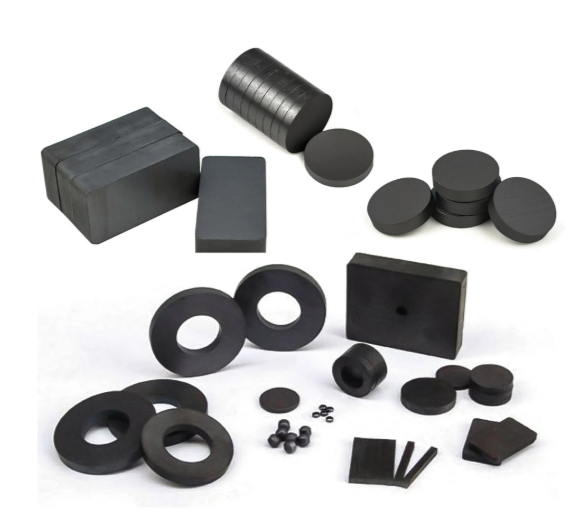
Transforming raw powders into a solid, functional component requires strict thermal and mechanical controls. Here is the six-step process used in top-tier industrial facilities.
The raw chemical powders are first mixed and subjected to thermal decomposition, known as calcining. We heat the mixture in large kilns to temperatures between 1000°C and 1350°C. This intense heat drives off carbon dioxide and creates a new metallic oxide compound. However, the resulting material is completely non-magnetic and highly clumped at this stage.
Next comes a critical mechanical step: micro-milling. The calcined material is crushed and milled down to a remarkably fine powder. The industry standard requires reducing these particles to under 2 microns. For context, a human hair is roughly 75 microns wide. We mill it this fine to ensure each individual particle constitutes a single magnetic domain. If the particles are too large, multiple magnetic domains form inside a single grain, which severely weakens the final magnetic output.
Once the powder reaches the required microscopic size, it moves to the pressing stage. This is where you decide the fundamental performance characteristics of the component.
Dry Pressing (Isotropic): In this method, the dry powder is pressed into a mold without an external magnetic field and without moisture. Because the particles are not forced into a specific alignment, the resulting magnet is isotropic. It has a multi-directional magnetization capability. This approach offers lower tooling costs and faster production rates, but it yields a lower overall magnetic energy.
Wet Pressing (Anisotropic): If you require high performance, the powder is mixed into a water-based slurry. We press this slurry inside a mold while applying a massive external magnetic field. The moisture acts as a crucial lubricant. It allows the microscopic crystals to physically rotate and align perfectly with the external magnetic field. As the press squeezes the water out, this highly aligned state is locked in. The result is a highly directional, superior magnetic strength.
Immediately after pressing, the material forms what we call a "green body." It holds its shape, but it is exceptionally fragile. It feels somewhat like tightly packed chalk.
Handling green bodies presents significant manufacturing risks. To maintain structural integrity before thermal fusion, facilities follow strict protocols:
Automated Extraction: Robotic arms gently remove the green bodies from the press to prevent human handling damage.
Climate Control: We store the bodies in climate-controlled environments to slowly evaporate residual moisture. Rapid drying causes micro-fractures.
Vibration Isolation: Conveyor systems are dampened. Even minor vibrations can cause the un-sintered edges to crumble.
The delicate green bodies now enter the high-temperature sintering furnace. We heat them slowly to temperatures ranging between 1100°C and 1300°C. This is the fusion phase.
During sintering, the physical transformation is absolute. The microscopic particles literally fuse together. The density of the material increases dramatically, closing internal microscopic pores. At the end of this thermal cycle, the final ceramic structure is permanently set. It transitions from a fragile piece of packed powder into a hard, dense ceramic.
The resulting ceramic is highly brittle. It is also an excellent electrical insulator. These two mechanical realities dictate how we handle post-process shaping.
Because it does not conduct electricity, conventional wire spark erosion (Wire EDM) simply cannot be used. You cannot cut it with standard steel tools either, as the ceramic is far too hard. Instead, shaping requires specialized diamond-coated cutting tools and grinding wheels. Manufacturers use heavy water coolant during grinding to prevent heat fracturing. Through precise diamond machining, we can achieve standard dimensional tolerances, which typically sit at +/- 0.25mm or +/- 3% depending on the specific geometry.
Even after sintering and machining, the ceramic part is essentially inert. It possesses the potential for magnetism, but it generates no active magnetic field.
In the final step, we place the inert ceramic inside a custom magnetizing coil. A massive bank of capacitors discharges, exposing the part to a brief, immense electrical pulse. This localized field forces all the microscopic domains to snap into permanent alignment. The component instantly reaches complete magnetic saturation, becoming a fully functional product.
Manufacturing hard ceramics at scale involves profound engineering challenges. The most critical issue happens invisibly during the high-temperature sintering phase.
When the green bodies fuse in the furnace, they shrink as their density increases. However, this is not uniform. We face the distinct engineering challenge of asymmetric shrinkage.
Anisotropic materials shrink differently depending on the direction of their crystal orientation. They can shrink up to 35% in the direction of their magnetic orientation, but only about 10% on the perpendicular axis. If you try to press a complex, intricate shape, these radically different shrinkage rates build immense internal thermal stress. The part will warp severely, or worse, shatter entirely inside the kiln.
Top-tier manufacturers do not press highly intricate shapes directly if they can avoid it. Instead, they mitigate cracking risks through block-pressing. They press exceptionally large blocks where the lateral dimensions far exceed the thickness. Because the block is geometrically simple, it survives the asymmetrical shrinkage during sintering without warping. Once the block is fully cooled and stabilized, they use diamond cutting tools to subdivide it into the smaller, specific geometries you require.
Before committing to a production run, you must evaluate how these materials align with your specific application constraints.
You must balance the exceptionally low cost of this material against the extremely high magnetic output of rare-earth alternatives like Neodymium (NdFeB). Below is a summary chart illustrating this dynamic.
Evaluation Metric | Ferrite Component | Neodymium (NdFeB) |
|---|---|---|
Upfront Raw Material Cost | Very Low | High |
Magnetic Pull Force | Moderate | Extremely High |
Volume Required | Larger space needed | Compact space allowed |
Innate Corrosion Resistance | Excellent (No plating) | Poor (Requires plating) |
We must warn buyers regarding custom geometries. While the raw material itself is incredibly cheap, creating custom press molds carries high upfront tooling costs. Furthermore, extensive diamond machining for complex shapes drives up the unit price quickly. If you can design your product to utilize standard block, disc, or ring shapes, you bypass these heavy initial investments.
Where this material truly excels is in harsh environments. Because the manufacturing process fundamentally oxidizes the raw material, it boasts innate corrosion resistance. It is already oxidized, meaning it cannot "rust" further. This eliminates the need for expensive surface plating, making it ideal for marine and outdoor applications. Additionally, it offers high operating temperature thresholds, functioning reliably in environments up to 250°C without suffering irreversible demagnetization.
Understanding industrial ferrite production delivers tremendous strategic value. It ensures your engineering team designs components that are actually manufacturable. It also helps procurement set realistic budget expectations for complex tooling.
As you plan your next production cycle, keep these actionable next steps in mind:
Define the absolute maximum operating temperature your component will face.
Calculate the maximum available volume space in your assembly; remember, you will need a physically larger part compared to rare-earth alternatives.
Determine if you require the multi-directional flexibility of dry pressing or the sheer power of wet pressing.
Consult with your manufacturing partner early to see if standard dimensions can replace custom geometries to avoid diamond machining premiums.
A: No, creating a commercial-grade version is nearly impossible outside an industrial setting. DIY mixtures rely on iron oxide powder mixed with resins or binders. Because you lack an industrial high-pressure press, a 1300°C sintering kiln, and a high-voltage saturation coil, DIY versions suffer from extreme porosity. They yield negligible flux density compared to commercial grades.
A: The calcining and high-temperature sintering processes effectively create a densely oxidized ceramic material. Because the core ingredients have already undergone complete oxidation inside the kiln, the final component cannot "rust" or oxidize any further. This makes it naturally immune to standard environmental corrosion, entirely eliminating the need for nickel or zinc plating.
A: Immediately after the sintering process, "as-sintered" dimensions are relatively loose, typically falling between +/- 2% to 3% of the target size. However, post-sintering diamond grinding can achieve much tighter commercial tolerances. Depending on the specific axis and overall geometry, diamond tools can dial the accuracy down to +/- 0.1mm to 0.25mm.


