We are constantly trying to improve ourselves in new thoughts, new technology and new working methods.

Views: 0 Author: Site Editor Publish Time: 2026-04-24 Origin: Site


Modifying a finalized ferrite magnet is fundamentally different from machining standard metals. Their hard, brittle ceramic structure makes standard cutting methods dangerous. Volatile magnetic fields complicate the process further. Engineering teams frequently face a difficult tension. You might need custom dimensions immediately for a prototype. However, you face the severe risk of permanently degrading component performance. High heat, intense vibration, or improper tool selection can instantly scramble internal electrons. This physical disruption ruins the material entirely.
Fortunately, cutting these components is technically possible. You must follow strict engineering guidelines. Maintaining yield rates and magnetic integrity requires specific thermal controls. You also need directional precision and specialized abrasive equipment. In this guide, you will learn the physical realities behind demagnetization risks. We will explore core operational rules for safe modification. Finally, we will help you evaluate the best industrial machining technologies for your specific application.
Timing is Critical: Industrial best practice is to cut coarse embryo material before the final magnetization process.
Vibration = Demagnetization: High-frequency vibration and excessive heat physically scramble internal magnetic domain alignment, causing irreversible magnetic degradation.
Equipment Standard: Endless diamond wire saws and continuous water-cooling systems are the baseline for high-yield, precision modifications; standard drill presses or dry saws will cause micro-cracking and pose safety hazards.
Direction Matters: Cutting parallel to magnetic field lines preserves significantly more magnetic strength than cutting perpendicularly.
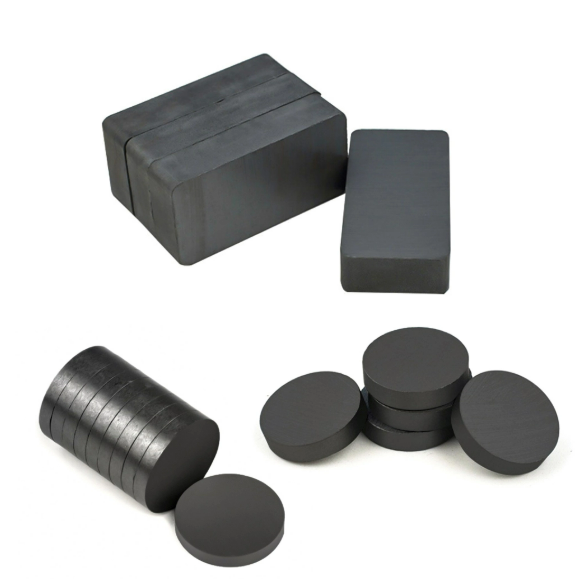
To safely machine Ferrite Ceramic Magnets, you must first understand their material composition. Manufacturers build these rigid composites using iron oxide (Fe2O3). They combine this base element with either strontium or barium carbonate. The resulting structure achieves high density. Despite this density, the material exhibits extreme brittleness. They behave more like industrial glass than standard steel alloys. Mechanical stress easily causes surface chipping. Rough handling will fracture the block entirely.
The demagnetization threat represents your biggest implementation risk. Magnetic loss occurs through basic physical principles. Mechanical shock misaligns internal magnetic electrons. Hammering or chiseling physically disrupts the delicate domain structure. Heat friction creates similar internal chaos. When electrons lose their parallel alignment, overall magnetic strength drops permanently. This degradation happens instantly and often silently.
Safety and compliance variables require strict attention. Dry magnetic dust poses significant health and facility risks. Airborne ceramic particulate is highly toxic upon inhalation. It is also surprisingly flammable. You must implement mandatory environmental controls in your machine shop. Never attempt a dry cut on these composites. Use continuous liquid coolant to suppress dust and manage heat. Install industrial-grade filtration systems to capture waste. You should also utilize localized exhaust setups directly above the machining zone.
Material Constraint | Physical Cause | Machining Risk |
|---|---|---|
Extreme Brittleness | Ceramic composite structure (Fe2O3) | Micro-cracking, edge chipping, catastrophic shattering under pressure. |
Thermal Sensitivity | Electron domain volatility | Irreversible demagnetization if temperatures exceed material thresholds. |
Hazardous Byproducts | Toxic and flammable particulates | Respiratory hazards and potential ignition if dry cut. |
You must map the magnetic poles before tooling begins. Operators often skip this step and ruin the component. Use a simple pole indicator or magnetic viewing film. Identify the exact flow of the North and South poles. Your cutting orientation directly dictates the surviving magnetic strength.
Cutting parallel to the field lines minimizes flux disruption. The blade slides alongside the electron flow. This orientation preserves the majority of the original magnetic pull. Conversely, severing the component perpendicularly heavily degrades the overall coercivity. You physically cut across the aligned domains. This action forces the material to establish a weaker, fractured magnetic field.
Step 1: Apply magnetic viewing film to locate the neutral line.
Step 2: Mark the exact parallel axis using a non-graphite industrial marker.
Step 3: Align the cutting blade perfectly with this drawn axis.
Step 4: Proceed slowly to prevent the blade from drifting across field lines.
Manual holding is universally forbidden. Human hands cannot prevent microscopic vibrations. Even tiny tremors will scramble the internal domain alignment during abrasive contact. You must establish strict immobilization protocols before powering up any equipment.
Use non-magnetic heavy-duty vises to lock the block in place. Brass or specialized polymer clamps work best. Ferrous clamps can distort the local magnetic field during the procedure. Tighten the vise firmly to eliminate micro-vibrations during the cutting stroke. Add rubber dampening pads between the clamp and the ceramic surface. This prevents the vise itself from causing compression fractures.
You must set realistic expectations regarding magnetic loss. Even under perfect conditions, edge-effect demagnetization occurs. The sheer physical trauma of separating the ceramic matrix inherently weakens the exposed boundaries.
Commercial applications often require a dedicated demagnetize and remagnetize cycle. You cannot simply cut the block and deploy it into a sensitive sensor. First, use an industrial demagnetizer to wipe the chaotic residual field. Next, place the newly sized pieces into a controlled magnetizer machine. This machine applies a massive, uniform energy pulse. The pulse realigns the domains perfectly to the new physical dimensions.
Choosing the right equipment determines your project success. We evaluate equipment options based on three core metrics. First, we look at surface roughness (Ra). Second, we measure kerf loss, which dictates material waste. Finally, we analyze the thermal impact on the internal magnetic structure.
Technology | Thermal Impact (HAZ) | Kerf Loss (Waste) | Surface Roughness (Ra) |
|---|---|---|---|
Diamond Wire Saw | Zero (Cold-cutting) | Minimal (<0.2mm) | Exceptionally Smooth (<0.5μm) |
Waterjet | Zero (Liquid cooled) | Moderate (1.0mm - 1.5mm) | Rough (>3.0μm) |
Laser Cutting | Severe (High heat) | Extremely Low | Smooth |
The endless diamond wire saw represents the premier standard for this material. This cold-cutting process entirely prevents Heat-Affected Zones (HAZ). It utilizes a continuous wire loop coated in industrial diamond abrasive.
Pros: The kerf loss is practically negligible, usually sitting below 0.2mm. This efficiency saves thousands of dollars in material waste over long production runs. It leaves exceptionally smooth surface finishes. Operators routinely achieve Ra values under 0.5μm. You rarely need secondary polishing.
Cons: The main drawback is higher initial equipment capital expenditure. The machines require precise tension calibration. Wire loop replacements also add to ongoing consumable requirements.
Waterjet systems blast a high-pressure stream of water and garnet abrasive. This method provides excellent thermal management. You face absolutely zero risk of heat-induced demagnetization because the water neutralizes all friction heat instantly.
Pros: You can cut very thick blocks efficiently. The lack of heat preserves the magnetic integrity completely.
Cons: The stream leaves a rougher edge profile. You will typically see Ra values exceeding 3μm. This roughness mandates secondary water grinding to achieve tight tolerances. Additionally, high ongoing abrasive costs can strain operational budgets.
Laser systems use concentrated light energy to vaporize the ceramic material. They offer high precision for highly complex or highly customized shapes.
Pros: Lasers excel at rapid prototyping for intricate designs. They handle micro-adjustments well.
Cons: Lasers have strict thickness limitations. They typically fail on material thicker than 3mm. Furthermore, the localized heat generates a distinct HAZ. This zone permanently alters the magnetic properties directly at the edge. The intense thermal shock can also induce micro-cracking in the brittle ceramic structure.
Engineering teams frequently hit a scalability bottleneck. Trying to cut pre-magnetized inventory in-house drains labor hours. Ordering custom sizes directly from a foundry solves this issue. Modifying finished stock rarely works for high-volume demands.
The factory workflow offers a distinct advantage. Specialized facilities do not cut finished, magnetized blocks. They process the material sequentially to eliminate magnetic disruption completely.
Coarse Embryo Material: The factory forms the raw composite into a rough block.
Thermal Treatment: The block undergoes sintering to solidify the ceramic matrix.
Water Grinding/Cutting: Diamond tools slice the unmagnetized block safely.
Surface Polishing: Abrasive wheels refine the edges to exact tolerances.
Magnetization (Final Step): The finished, perfect shape receives its magnetic charge.
Understanding tolerance realities shifts engineering perspectives. Specialized factories can hit micro-tolerances effortlessly. For example, they routinely achieve minimum sizes of L2 x W2 x 0.8mmt. They do this with near-zero defect rates. This level of precision is virtually impossible to replicate by retrofitting finished pieces in a standard machine shop.
We recommend a strict shortlisting logic for your projects. Engineering teams should only cut finished stock for rapid prototyping. If you need a quick proof of concept, wet-cutting a spare block makes sense. However, for production runs, transition immediately to factory-direct custom tooling. This approach ensures safety compliance. It also guarantees predictable magnetic performance across thousands of units.
Modifying a finished ceramic magnetic component remains an exercise in damage mitigation rather than enhancement. You are actively trying to prevent material degradation at every step. Success depends entirely on strict procedural adherence.
The ultimate decision framework is clear. You must control heat buildup constantly. Eliminate all mechanical vibration through heavy-duty immobilization. Respect the parallel magnetic field lines during orientation. Always utilize diamond abrasives paired with continuous wet coolant.
We highly encourage buyers and engineers to rethink their supply chains. Consult with dedicated manufacturers for custom dimensions early in your design phase. Avoid absorbing the severe material waste and intense labor costs of in-house processing. Proper factory tooling delivers superior tolerances and perfect magnetic saturation.
A: No. Cutting a magnet does not invert its polarity. However, the exact point of the break immediately establishes a new North and South pole for each resulting piece. You will simply have two smaller functional pieces, each with their own complete magnetic field.
A: It is strongly discouraged. Hacksaws will blunt instantly and shatter the ceramic. A Dremel with a diamond rotary bit can work for minor micro-adjustments. However, you must operate it at very low RPMs with continuous water coolant to prevent toxic, flammable dust and heat damage.
A: Using advanced endless diamond wire loops, commercial manufacturers can comfortably process pieces down to a thickness of 0.8mm. They routinely achieve tolerances as tight as ±0.02mm, which is impossible using dry-cutting methods or standard shop tools.


