We are constantly trying to improve ourselves in new thoughts, new technology and new working methods.

Views: 0 Author: Site Editor Publish Time: 2026-05-01 Origin: Site


Magnetic interference remains a persistent engineering and operational concern for sensitive equipment. Does bringing a magnet near modern devices invite disaster? System integrators often face this exact question when designing new products. We must clearly distinguish between modern solid-state electronics and legacy mechanical devices to find the answer. Powerful rare-earth options like neodymium pose distinct threats to various mechanisms. However, a standard ferrite magnet (strontium or barium carbonate ceramic) operates on a much lower magnetic output scale.
You will discover an evidence-based framework below. This guide helps engineers and buyers evaluate magnetic risks and establish effective spatial isolation protocols. We will also explore where these specific materials actually solve electronic interference problems rather than cause them.
Static vs. Dynamic Fields: Constant, static magnetic fields from ferrite magnets cannot erase modern solid-state memory (SSDs/Flash) or damage PCBs; risks only arise from rapid relative motion (induced voltage).
Inherent Material Safety: The lower flux density of Ferrite Ceramic Magnets makes them significantly safer around consumer electronics compared to NdFeB magnets.
The "Sensitive" Margin: Critical vulnerabilities remain for specific mechanisms: Hall-effect sensors, low-coercivity (LoCo) magnetic cards (failure at 30 Gauss), and unshielded medical implants (triggers at 10 Gauss / 1 mT).
The Paradox of Protection: Far from disrupting devices, ferrite materials are integral to modern electronics, utilizing their high electrical resistivity to suppress high-frequency EMI (Electromagnetic Interference) via ferrite cores and beads.
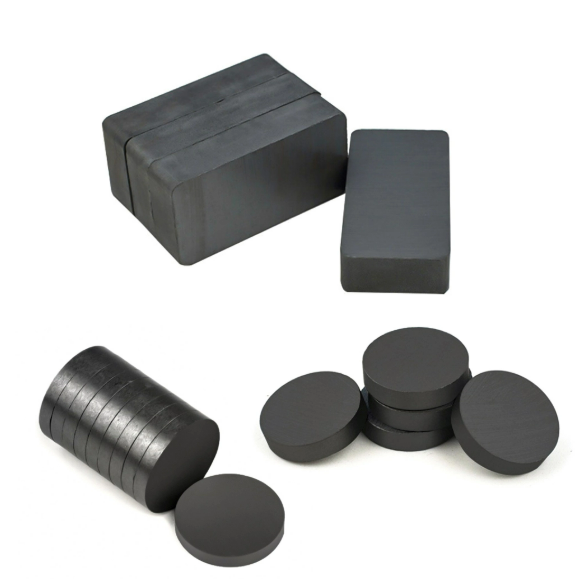
We often misunderstand how magnetic fields interact with circuit boards. Electronic damage requires an induced voltage to cause actual harm. A stationary ferrite magnet resting near a printed circuit board generates zero current. This concept relies entirely on Faraday’s Law of Induction. When a magnetic field moves rapidly, it cuts across the conductive traces of the PCB. This high-speed relative motion pushes electrons, generating a voltage spike. Because a stationary object does not move, it cuts no lines of flux. Therefore, no harmful voltage exists. Static fields pose no threat to solid-state electrical flow.
Magnetic field strength also decays rapidly over physical distance. We calculate this drop using the inverse cube law ($1/r^3$). Doubling the distance reduces the field strength to one-eighth of its original power. The inherently moderate surface gauss of these materials drops to negligible background levels within mere millimeters. You do not need massive physical clearance to protect standard circuitry. The field simply cannot reach far enough to cause issues.
We must compare these materials to neodymium variants to understand the actual risk level.
Magnetic Penetration Depth: Neodymium magnets project disruptive fields several centimeters outward. They easily penetrate thick plastic casings. In contrast, a ceramic alternative produces a tightly localized field. It rarely penetrates past the outer device enclosure.
Thermal Stability Limits: Ferrite operates safely up to 250°C. It exhibits almost no field fluctuation under extreme heat. Standard neodymium risks permanent demagnetization around 80°C. This makes ceramic options much safer for high-heat electronic environments like engine bays.
Different components react uniquely to external magnetic forces. We can categorize these physical reactions into three distinct levels of vulnerability.
Modern memory systems are completely immune to static magnetic fields. USB drives, solid-state drives (SSDs), SD cards, and smartphones use NAND flash memory. They rely entirely on tiny electrical charges trapped inside memory cells. They do not use magnetic domains to store data at all. You cannot erase an SSD using any commercial magnet. Modern displays also fall into this immune category. LCD and OLED panels are completely unaffected by proximity. Obsolete CRT monitors relied on magnetically guided electron beams, but modern screens do not use this technology.
Some components experience temporary glitches when exposed to localized fields.
Sensors: Digital compasses, gyroscopes, and Hall-effect sensors will feed skewed data to the primary processor. Tablets and phones often require a manual software recalibration once you remove the magnetic source.
Acoustic Components: Device speakers and mechanical autofocus actuators in smartphone cameras use tiny internal magnets. External magnetic pull can temporarily jam these small moving parts. They usually recover perfectly once the external field vanishes.
A few specific technologies require strict spatial isolation. Magnetic stripe cards are particularly vulnerable. We must differentiate between HiCo (High Coercivity) and LoCo (Low Coercivity) cards. HiCo cards withstand external fields up to 400 Gauss. LoCo cards suffer total data failure at just 30 Gauss. A basic ferrite magnet easily wipes hotel keys or parking passes upon direct contact.
Mechanical watches also face permanent damage risks. External fields easily magnetize the internal balance spring. The magnetized spring sticks to itself, shortening its effective length. This alters the watch's timekeeping precision significantly, making it run very fast. Standard ISO 764 guidelines protect watches only up to 60 Gauss.
Component Type | Vulnerability Level | Failure Threshold / Mechanism | Recovery Type |
|---|---|---|---|
NAND Flash (SSD, SD) | Immune | N/A (Uses electrical charge) | N/A |
Smartphone Compass | Temporary Interference | Varies (Sensor confusion) | Software Recalibration |
LoCo Magnetic Card | Permanent Damage | 30 Gauss (Data wipe) | Requires Replacement |
Mechanical Watch | Permanent Damage | 60 Gauss (Magnetized spring) | Professional Demagnetization |
Strict safety thresholds are critical when placing magnetic components near specialized equipment. You must follow established guidelines to ensure user safety and system reliability across various environments.
Modern pacemakers often switch to a diagnostic "magnet mode" when exposed to magnetic fields. This mode triggers when the field exceeds 1 mT (10 Gauss). The 1 mT threshold acts as an internationally recognized safety standard. It ensures ambient fields do not accidentally alter the pacing rhythm. Standard healthcare guidelines mandate maintaining a 15cm (6-inch) safe distance for any concentrated magnetic source. Keep all magnetic components out of chest pockets to protect patients.
Unmanaged magnetic fields in manufacturing environments cause serious operational issues. They easily impact precision relays and micro-motors on the assembly line. Micro-motors rely on precise internal magnetic fields to rotate accurately. External interference can cause these motors to stutter, leading to misalignment. This interference causes measurable equipment downtime and production losses. We frame spatial isolation as a strict operational standard. Adhering to IEEE electromagnetic compatibility (EMC) guidelines prevents costly electronic failures. These standards help engineers map out safe installation zones for sensors.
Engineers must also consider edge-case proximity risks during product design. Permanently mounting magnets directly against Li-ion battery housings introduces hidden dangers. External magnetic fields interact with the internal battery chemistry and ferrous structural elements. This interaction can cause localized warming or erratic discharge behavior over time. Always leave a sufficient buffer zone between magnetic clasps and internal battery cells.
Many people assume all magnetic material acts as an inherent threat to electronics. We must shift this narrative completely. Soft ferrite actually plays a crucial, protective role in modern circuit design.
Ferrite beads and cores act as passive low-pass filters for electronic cables. They utilize the material's naturally high electrical resistance to solve interference issues. These components absorb high-frequency electromagnetic noise running along power cords. They then dissipate this unwanted energy safely as trace amounts of heat. This passive protection keeps your laptop and monitor signals perfectly clean. Without these components, unshielded cables act like antennas and absorb surrounding radio frequencies.
Engineers actively design Ferrite Ceramic Magnets into power supplies, transformers, and EV motors. They choose these materials for very specific functional advantages. Ceramic options provide necessary magnetic flux without conducting electricity. When conductive magnets spin in EV motors, they generate internal electrical currents. These internal eddy currents create massive amounts of heat. Because ceramic materials act as insulators, they completely block these internal currents. The motor stays cool and runs efficiently. Furthermore, utilizing these materials helps manufacturers avoid the volatile rare-earth supply chain.
Product designers must implement specific protocols when integrating magnetic components near sensitive electronics. Proper planning eliminates almost all associated risks.
Calculate the minimum required air gap before finalizing your product chassis. If you design a tablet dock or magnetic closure, check the Gauss level at the PCB surface. You must drop the localized field strength below the threshold of sensitive components like Hall-effect sensors. A few millimeters of extra plastic casing often solves the entire problem, dropping the interference to zero.
Sometimes close physical proximity is entirely unavoidable due to form-factor constraints. Introduce Mu-metal or high-permeability steel shielding in these exact scenarios. These specialized materials redirect the magnetic flux lines effectively. They actively pull the field away from critical PCBs, micro-motors, or battery housings. Proper shielding allows you to place strong magnetic latches very close to sensitive processors safely.
You must establish strict B2B logistics guidelines for assembly and shipping.
Keep strong external magnetic fields (like Neodymium) at least 30mm away from ferrite components during shipping.
Prevent accidental demagnetization or polarity reversal of the softer ceramic materials.
Mandate dedicated non-magnetic workstations for your assembly staff.
Keep calibrated sensors far away from bulk magnetic storage bins on the factory floor.
A static magnetic field will never fry your modern electronics or erase solid-state data. The genuine risks remain highly localized, mostly mechanical, and entirely predictable. You can easily manage these factors through basic spatial awareness and proper material selection.
Map the clearance limits for specific sensors, older legacy media, and unshielded medical implants during early design phases.
Leverage the exceptional thermal stability and EMI-suppressing nature of ceramic magnetic components for power applications.
Apply basic air gaps or Mu-metal shielding whenever you must place magnets near battery housings or mechanical relays.
Implement strict 30mm isolation rules during logistics to prevent stronger rare-earth materials from altering your ceramic components.
A: No. Modern devices use non-magnetic solid-state memory. They store data using tiny electrical charges, not magnetic fields. The most a magnet will do is temporarily confuse the digital compass or gyro sensor until you move the device away.
A: Generally, no. While HDDs use magnetic storage, the platters possess extremely high coercivity. The internal mechanics are heavily shielded by thick metal casings. A standard external ferrite magnet lacks the strength to penetrate this casing and alter the data.
A: While ferrite is significantly weaker than neodymium, safety protocols dictate keeping any intentional magnetic source at least 15 cm (6 inches) away from the medical implant. This clearance guarantees you will not trigger diagnostic test modes accidentally.
A: Soft ferrite materials are excellent electrical insulators. Instead of projecting a strong magnetic field, they absorb unwanted high-frequency electronic noise (EMI) running along the cable. They convert this noise into trace heat, protecting the device from external signal interference.


